1. Introduction
Among the geometric forms engraved, painted, or sculpted by humans since the Neolithic, the spiral occupies a special place. It appears on every continent, in very different archaeological contexts, across epochs separated by millennia. This ubiquity has fueled interpretations ranging from a universal cosmic symbol to a simple decorative solution. This article examines what archaeology and cognitive science allow us to assert, and what they invite us to leave open.
2. Major Sites and Chronology

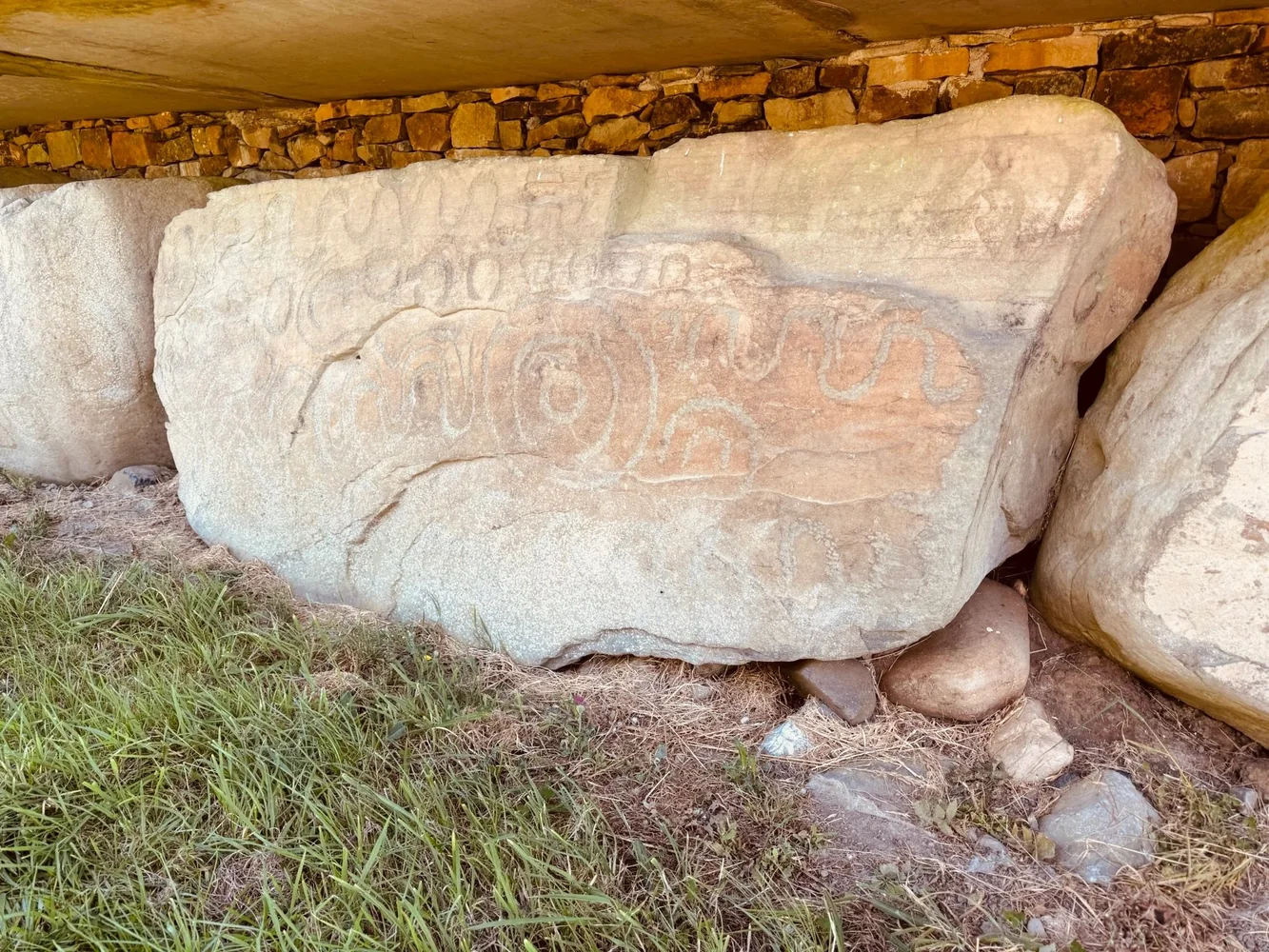
Newgrange (Brú na Bóinne) in Ireland is one of the best-documented examples. This Neolithic monument, dated to approximately 3200 BCE, predates the Pyramids of Giza and Stonehenge. Its entrance stone bears a triple spiral (triskelion) and double spirals, among the most complex motifs in European megalithic art. The orientation of the central passage, which is illuminated at the winter solstice, suggests an astronomical or ritual function, but the precise meaning of the spirals remains unknown.
In the southwestern United States, petroglyphs of the Ancestral Puebloan cultures (Anasazi) include numerous spirals, some associated with solar markers. At Chaco Canyon (New Mexico), a site on Fajada Butte uses stone slabs to project a light ray onto an engraved spiral at solstices and equinoxes. This interpretation, proposed by Anna Sofaer in 1977, remains debated as to whether it was intentional or coincidental.
In the Mediterranean, the megalithic temples of Malta (Tarxien, Ħaġar Qim), dated to 3600–2500 BCE, display spiral reliefs on altars and facades. In Asia, spirals appear on Chinese Neolithic ceramics (Yangshao culture, 5000–3000 BCE) and on Bronze Age bronzes (Sanxingdui culture). In Oceania, Maori tattoos (tā moko) and wood carvings use spirals (koru) representing growth, new life, and connection to ancestors.
In South America, the Nazca geoglyphs (Peru), dated from 100 BCE to 800 CE, include lines and geometric shapes, some of which are spirals. Their function remains debated: astronomical calendar, pilgrimage routes, offerings to water deities. Spirals are a minority there compared to straight lines and animal figures.
3. Construction Techniques
A spiral can be traced in several ways with simple tools. The most elementary method consists of progressively winding a line around a center, increasing the radius with each turn. This technique requires neither compass nor ruler: a continuous wrist movement suffices. Ease of production is one reason why the spiral appears early in the history of art.
For more regular spirals, such as those at Newgrange, experimental studies have shown that a primitive compass (a cord fixed to a pivot) can produce regular circular arcs which, chained together, yield an approximate Archimedean spiral. Geometric analysis of the Newgrange spirals by Alasdair Whittle and other researchers has revealed a regularity suggesting the use of a measuring tool, without it being possible to identify which one.
The engraving technique (pecking, incision, abrasion) and materials (sandstone, granite, limestone, clay) influence the final form. Spirals on ceramics are often more regular than those on rock, because fresh clay allows corrections. Painted spirals (ochre, charcoal) can be freer. These technical constraints contribute to the variability of observed forms.
4. Interpretations: What Archaeology Can and Cannot Say
The interpretation of prehistoric motifs is one of the most difficult problems in archaeology. In the absence of explanatory texts and demonstrated cultural continuity, any attribution of meaning is a hypothesis. Archaeologists generally distinguish several levels of analysis: formal description (form, technique, location), archaeological context (association with other objects, structures, funerary practices), and symbolic interpretation (supposed meaning).
Archaeological context is the first filter. A spiral engraved at the entrance of a funerary mound (Newgrange) probably does not carry the same meaning as a spiral on a domestic ceramic or an isolated petroglyph on an outdoor rock. Association with astronomical alignments, votive deposits, or specific funerary practices can guide interpretation without determining it.
The interpretations proposed in the literature are numerous and often contradictory: representation of the sun or moon, symbol of water or seasonal cycles, representation of the soul or journey to the afterlife, territorial marker, decorative motif without strong symbolic meaning, representation of entoptic phenomena (phosphenes) linked to altered states of consciousness. None of these hypotheses is universally accepted, and several may coexist for different sites.
The oral traditions of communities whose ancestors produced these works are a valuable source, but their use requires caution. An oral tradition may have evolved over millennia; it may reflect recent rather than original interpretations; and it may be claimed by multiple groups with different versions. Archaeologists increasingly work in collaboration with concerned communities (collaborative archaeology, UNDRIP), which enriches interpretation without making it definitive.
5. Visual Cognition and Relative Universality
Part of the ubiquity of the spiral in prehistoric art can be explained by universal cognitive and perceptual factors. The entoptic theory, developed by David Lewis-Williams and Thomas Dowson from the 1980s onward, proposes that certain recurring geometric motifs in rock art (spirals, grids, dots, zigzags) correspond to visual phenomena generated by the nervous system itself during altered states of consciousness (trance, fever, sensory deprivation, psychoactive substance use).
These entoptic phenomena (from the Greek entos, inner, and optikos, visual) are produced by spontaneous activity of the visual cortex and are culture-independent. They include phosphenes (light spots), simple geometric shapes, and spiral patterns. If this theory is correct, it would explain why similar motifs appear in cultures without contact, without implying identical meaning.
The entoptic theory has been criticized for being too general and for the risk of reducing all rock art to trance states. Researchers such as Iain Davidson and Paul Taçon have pointed out that the presence of a geometric motif in rock art does not prove it was produced in an altered state of consciousness, nor that its meaning is entoptic. The spiral is also easy to trace consciously and deliberately.
A complementary explanation is the visual salience of the spiral. A form that combines rotation and expansion is perceptually distinctive: it attracts the gaze, suggests movement, and remains recognizable despite variations. These properties may favor its use in contexts where visibility and memorability are important, independently of any altered state of consciousness.
6. Transcontinental Comparisons: Methodological Caution
The presence of spirals on several continents has sometimes been interpreted as evidence of prehistoric cultural contact or a common origin. This interpretation is generally rejected by archaeologists for several methodological reasons.
First, the similarity of a simple form does not constitute evidence of contact. To establish cultural diffusion, one would need a complex and specific set of traits (not just a spiral, but a particular combination of motifs, techniques, contexts, and symbolic associations), a compatible chronology (sites in supposed contact must be contemporary or in a temporal order consistent with the direction of diffusion), and independent material evidence (exchanged objects, human remains, genetic analyses).
Second, independent convergence is a credible alternative explanation for simple forms. Populations without contact can produce similar solutions to similar problems (how to represent rotational movement, how to fill a surface in a visually interesting way). Convergence is well documented in evolutionary biology and technology; it is equally plausible in art.
Third, prehistoric datings have significant uncertainty margins. Two sites dated to the same millennium may be separated by several centuries, making it difficult to establish the strict contemporaneity required for the contact hypothesis.
7. The Prehistoric Spiral in the Project
Prehistoric spirals perfectly illustrate the central thesis of the "Spirals Everywhere" project: very different domains (biology, physics, mathematics, human culture) can converge toward similar forms without sharing a common mechanism. The prehistoric spiral is not the result of a physical law or biological constraint; it is the product of human cognition, the perceptual properties of the form, and the technical constraints of production.
This graphic convergence is real and documented. But it does not prove a universal meaning, cultural contact, or common origin. It shows instead that certain forms are cognitive attractors: solutions that independent human minds naturally find when seeking to represent movement, growth, or transformation. The uncertainty about the precise meaning of each spiral is not a weakness of the analysis; it is an intellectual honesty that protects the works against an overly hasty modern reading.
First describe what is visible
Description begins with observable properties: number of branches, winding direction from a stated starting point, line connections, interruptions and placement on the surface. The word spiral identifies neither function nor maker. An actual engraved line must be distinguished from a contour inferred through lighting, erosion or photography. An archaeological tracing documents such uncertainties; a decorative drawing cannot replace it.
The three motifs below are original sketches comparing windings. They reproduce no stone and provide no evidence about a culture. A geometric example can explain a family of forms, whereas site documentation needs scale, provenance, recording conditions and rights information. Official Brú na Bóinne resources provide context for actual motifs in their archaeological setting. [1]
Context supplies information absent from shape
A spiral on a wall, passage stone or portable object does not have the same context. Position, associations, technique and surface history contribute to interpretation. Dating a monument does not automatically date every visible mark: a surface can record several interventions. State whether chronology comes from an associated layer, superposition or stylistic attribution, since these arguments have different scope.
Brú na Bóinne is an archaeological ensemble in the Boyne valley including Newgrange, Knowth and Dowth. UNESCO describes a landscape of monuments and megalithic art, not a catalogue of fully decoded symbols. This contextual scale prevents reducing the site to one isolated image. The following schematic outlines an interpretive method; it invents no stratigraphy or dating for a particular stone. [2]
Geometry describes regularity, not intention
An Archimedean spiral has radius increasing linearly with angle, keeping a constant radial gap between successive turns. A logarithmic spiral multiplies radius by a constant factor over a fixed angle, so turn spacing grows. These models provide comparative vocabulary. A hand engraving can resemble either, or vary between them, without having been constructed from an equation.
Testing a resemblance would require a calibrated tracing, perspective correction, an explicitly chosen center and error estimates. Fitting several parameters to a short curve can produce a good match by chance; alternative simple models must be compared. One curve alone establishes neither the golden ratio, formal mathematical knowledge nor a particular cosmology. Mathematics helps describe spacing without turning a proposed intention into archaeological fact.
Comparing interpretations without conflating them
Decoration, spatial organization, reference to a cycle and ritual use are possible hypotheses to document, not automatic translations of an image. An interpretation gains support when it also explains associations, locations and repetitions and withstands plausible alternatives. Similarity across continents alone does not prove transmission: similar gestures and constraints can independently produce related shapes.
Institutional descriptions of Brú na Bóinne provide a checkable starting point for monuments and art, distinct from later symbolic interpretations. The final sketch preserves that distinction: shape directly supports geometric description; meaning requires additional contextual evidence. This does not diminish the images’ richness. It allows several readings while clearly identifying what is established and what remains open. [1] [2]
References
- [1]Office of Public Works, Heritage Ireland. (s.d.). Brú na Bóinne Visitor Centre: Newgrange, Knowth and Dowth. https://heritageireland.ie/places-to-visit/bru-na-boinne-visitor-centre-newgrange-knowth-and-dowth/ [accessed 2026-10-19]
- [2]UNESCO World Heritage Centre. (s.d.). Brú na Bóinne — Archaeological Ensemble of the Bend of the Boyne. https://whc.unesco.org/en/list/659/ [accessed 2026-10-19]