Scientific explorations of spirals and convergence phenomena in mathematics, physics, biology, astronomy, computer science and complex systems.
9 articles · Biology
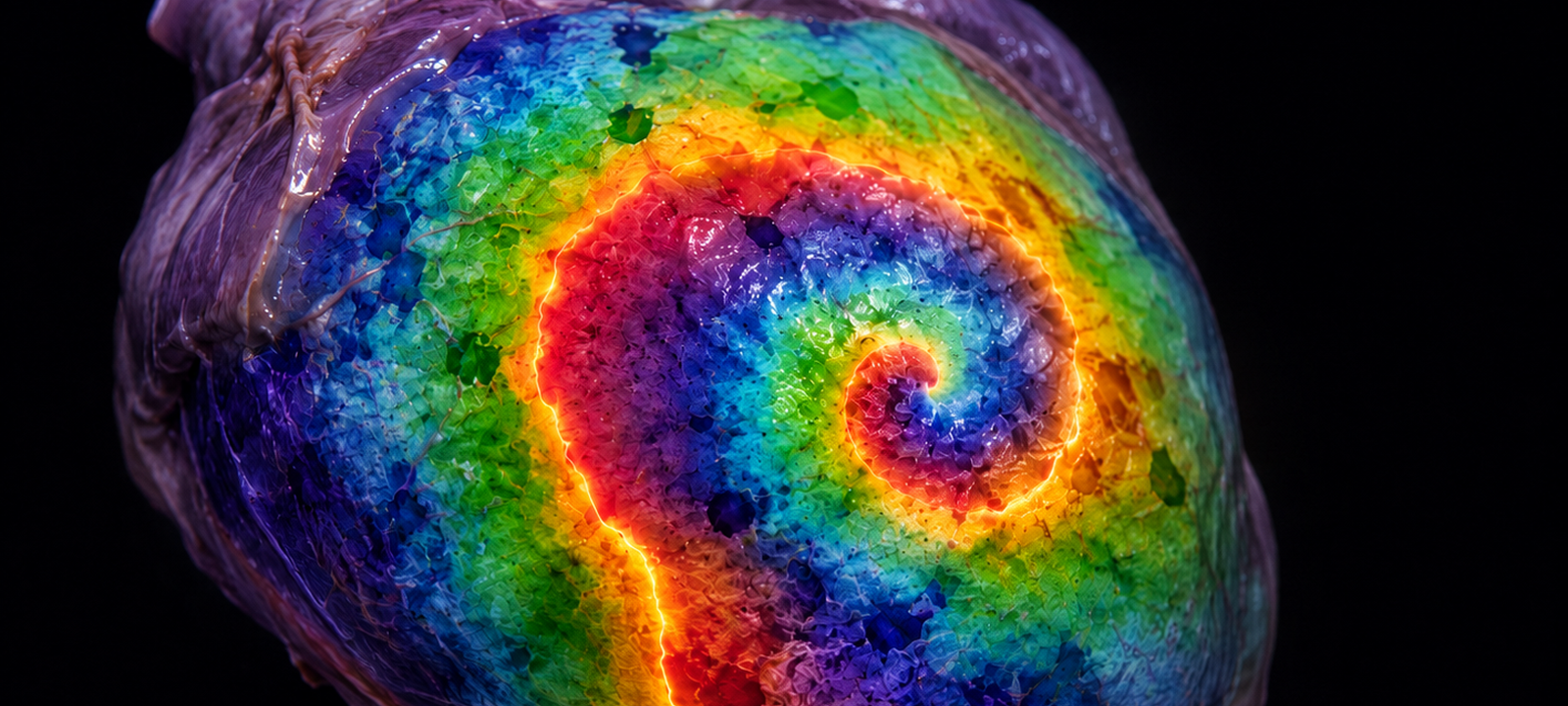
Every serious arrhythmia conceals an electrical spiral rotating indefinitely in the myocardium. This article explores the physics of reentrant waves, from the FitzHugh-Nagumo model to realistic ionic models, and the strategies for breaking these lethal spirals.
The spirals of a sunflower are not drawn by a central plan. They emerge from the successive position of new organs around a meristem, under the effect of local growth and space constraints.
DNA is a helix, not a flat spiral. Its shape results from the geometry of nucleotides, base stacking, hydrogen bonds and the aqueous environment.
A shell grows by adding material at its opening. When proportions remain stable, its shape can be modeled by a logarithmic spiral, but each species has its own parameters.
Apical meristems are the growth zones of plants. The way these cells divide and organize produces spiral arrangements, governed by the same equations as phyllotaxis.
The alpha helix is one of the two fundamental secondary structures of proteins. It forms because hydrogen bonds between amino acids spaced four residues apart create a helical geometry that minimizes free energy.
The ram's horns, the mammoth's tusks, the narwhal's tusk grow in a spiral. The reason is biomechanical: helical growth distributes mechanical stresses optimally.
Migratory raptors use rising columns of warm air to gain altitude without expending energy. They spiral upward in these columns, then glide in a straight line to the next thermal.
The bacterial flagellum is a rigid helix driven by a rotary molecular motor. The helical geometry converts rotation into translation with remarkable efficiency.