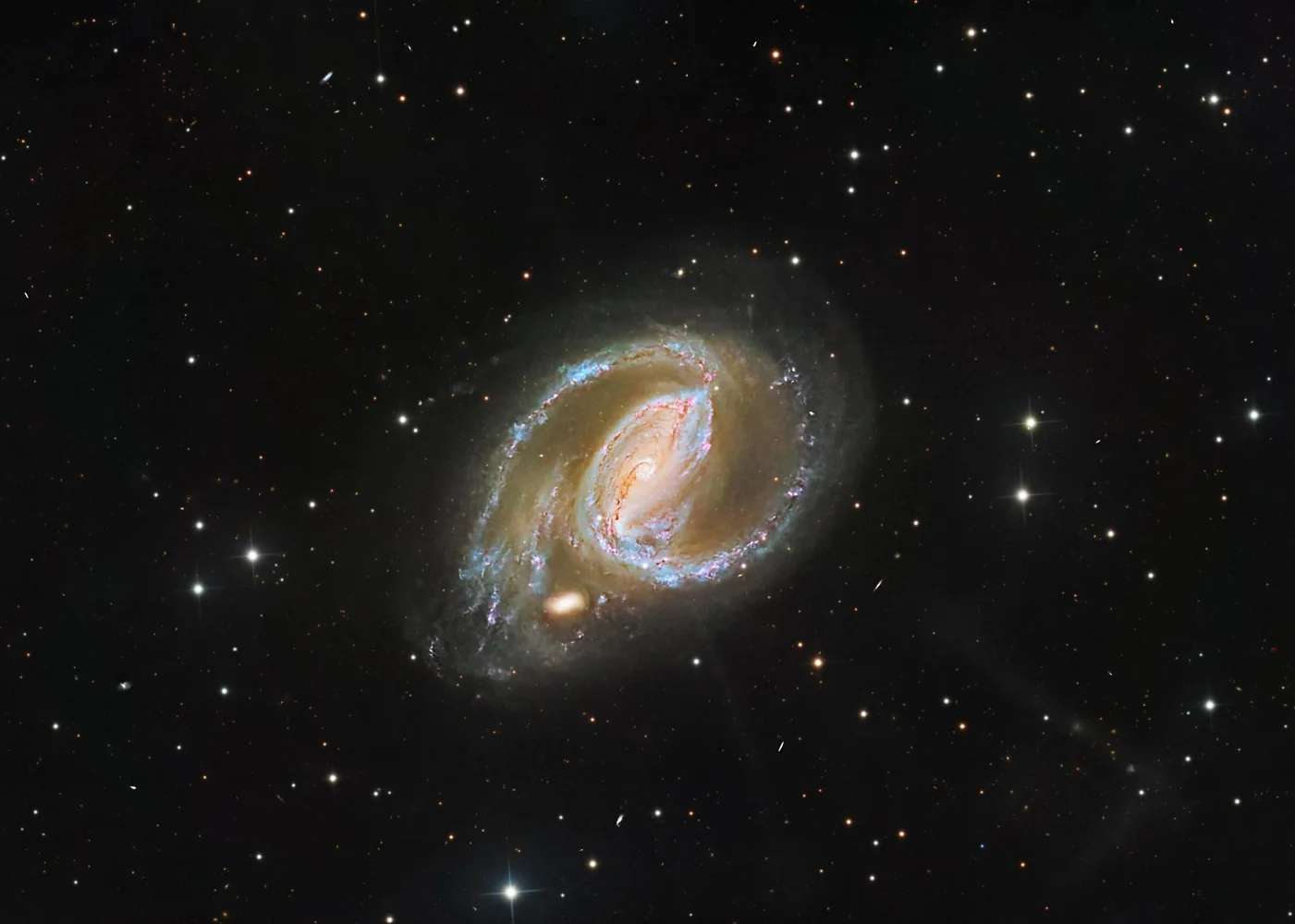
1. Introduction
The spiral arms of galaxies are among the most spectacular structures in the observable universe. They concentrate the formation of massive stars, luminous HII regions and giant molecular clouds. Yet their very existence poses a fundamental problem: in a differentially rotating galactic disk — where stars near the center orbit faster than those at the periphery — any material arm-shaped structure should wind up and disappear within a few galactic rotations, i.e. a few billion years. Yet spiral galaxies are ubiquitous in the local universe, and their arms have persisted for tens of billions of years.
2. The Winding Problem
Differential rotation is a fundamental property of galactic disks. Unlike the solar system where virtually all the mass is concentrated in a single central object (the Sun), the mass of a galaxy is distributed throughout the disk and in a dark matter halo. This results in a nearly flat rotation curve: the orbital velocity V(R) remains approximately constant over a wide range of radii R, instead of decreasing as V ∝ (Keplerian law).
If spiral arms were rigid material structures — ribbons of physically bound stars and gas — differential rotation would inexorably wind them up. Assuming an angular velocity Ω(R) = V/R decreasing with R, an initially radial arm would transform into an ever-tighter spiral. After only two or three galactic rotations (4 to 6 billion years for the Milky Way), the arm would be so tightly wound as to become indistinguishable. This paradox, clearly formulated in the 1960s, is known as the winding problem.
Angular difference between two points of the arm at radii and after time t. For a flat rotation curve, Ω ∝ , and Δφ grows linearly with t.
3. Lin and Shu's Theory
The solution to the winding problem was proposed in 1964 by Chia-Chiao Lin and Frank Shu of the Massachusetts Institute of Technology. Their central idea is that spiral arms are not material structures but quasi-stationary density waves propagating through the galactic disk. The distinction is fundamental: stars and gas pass through the arms, just as cars pass through a slowdown on a highway. The slowdown (the density wave) remains roughly fixed in the rotating frame, while the cars (the stars) continuously pass through it.
In Lin-Shu theory, spiral arms are regions where stellar and gas density is slightly above average. This overdensity creates a slightly deeper gravitational potential that attracts surrounding stars and gas, slows them, and temporarily holds them in the arm region. The density wave propagates at a pattern angular velocity Ω_p (pattern speed), different from the stellar angular velocity Ω(R). For most spiral galaxies, Ω_p is approximately constant with R, which allows the wave to maintain a coherent spiral shape.
Lindblad resonance condition, where m is the number of arms, Ω the orbital angular velocity, Ω_p the pattern speed, and κ the epicyclic frequency. The + sign corresponds to the inner Lindblad resonance (ILR), the − sign to the outer Lindblad resonance (OLR).
Lin-Shu theory predicts that spiral arms should have a logarithmic shape: r = · , where i is the pitch angle of the arm relative to the tangential direction. Observations confirm that most spiral arms are well approximated by logarithmic spirals, with typical pitch angles of 10° to 30°. This shape is a direct consequence of wave dynamics in a flat-rotation-curve disk.
4. Lindblad Resonances
Bertil Lindblad, the Swedish astronomer, had anticipated as early as the 1940s the importance of orbital resonances in galactic dynamics. A star orbiting in the galactic disk not only revolves around the center but also undergoes radial (epicyclic) oscillations at frequency κ. When the frequency at which a star encounters the spiral arms (m(Ω − Ω_p)) equals ±κ, the star is said to be at a Lindblad resonance.
5. Swing Amplification and Instabilities
Lin-Shu theory in its original version assumes quasi-stationary waves of fixed amplitude. But how are these waves generated and sustained? An important mechanism is swing amplification, described by Goldreich and Lynden-Bell (1965) and Julian and Toomre (1966). This mechanism exploits differential rotation to amplify initially weak density perturbations.
A density perturbation initially oriented in the direction of the wind (leading, inclined in the direction of rotation) is progressively turned by differential rotation to become a trailing perturbation (inclined against rotation). During this turning, the perturbation can be amplified by a factor of 10 to 100 if the Toomre parameter Q is close to 1. The Q parameter measures the gravitational stability of the disk: , where σ is the stellar velocity dispersion, G the gravitational constant and Σ the disk surface density.
Toomre parameter. Q < 1: gravitationally unstable disk, intense star formation. Q ≈ 1: marginally stable disk, maximum swing amplification. Q > 1: stable disk, no spontaneous star formation.
In real galaxies, the disk is maintained near Q ≈ 1 by a self-regulation mechanism: if Q drops below 1, star formation accelerates, heats the gas and increases σ, which brings Q back above 1. This feedback mechanism maintains the disk in a marginally stable state, conducive to swing amplification and thus to the maintenance of spiral structures.
6. Star Formation in Spiral Arms
Spiral arms are regions of intense star formation. When interstellar gas crosses a density wave, it is compressed. If the compression is sufficient for the local density to exceed the Jeans threshold, the gas gravitationally collapses to form stars. The Jeans mass depends on temperature T and density ρ: compression increases ρ and decreases , favoring collapse.
The spatial sequence observed in spiral arms reflects the chronology of star formation. Upstream of the density wave (in the direction of galactic rotation), giant molecular clouds (GMCs) of cold gas are observed. In the wave itself, HII regions ionized by young massive stars (O and B type). Downstream, OB associations of still-young massive stars, then open clusters of older stars. This sequence, observed in galaxies like M51 (the Whirlpool Galaxy), confirms that star formation is triggered by the passage of the density wave.
Massive stars formed in spiral arms have short lifetimes (a few million years) and explode as supernovae before having time to move significantly away from the arm. Their supernovae enrich the interstellar medium with heavy elements and create bubbles of hot gas that can trigger a new generation of star formation (sequential star formation or propagation). Low-mass stars, on the other hand, survive well beyond the passage of the arm and disperse into the galactic disk.
7. Galaxy Interactions and Tidal Spirals
Not all spiral structures are quasi-stationary density waves. Gravitational interactions between nearby galaxies can generate tidal spiral arms — tidal tails and bridges of matter torn away by tidal forces. These structures are transient and persist only for a few hundred million years after the interaction. The galaxy M51 (NGC 5194) and its companion NGC 5195 are the most famous example: the companion passed through M51's disk about 500 million years ago, triggering and amplifying its spiral arms.
N-body numerical simulations have played a crucial role in understanding spiral structures. The first simulations by Miller, Prendergast and Quirk (1970) showed that self-gravitating particle disks spontaneously develop transient spiral structures, even without external perturbation. These flocculent spirals — irregular and fragmented, unlike the grand design spirals of Lin-Shu theory — are generated by swing amplification of random perturbations.
The morphological distinction between grand design galaxies (like M51 or M81, with two well-defined symmetric spiral arms) and flocculent galaxies (like NGC 2841, with many fragmented and irregular arms) probably reflects the difference between quasi-stationary density waves sustained by an external perturbation or a central bar, and transient spirals generated by swing amplification of gravitational noise.
8. The Spiral Arms of the Milky Way
Mapping the spiral arms of the Milky Way is particularly difficult because we are inside the galactic disk, embedded in interstellar dust that absorbs visible light. The main techniques are radio astronomy (21 cm line of neutral hydrogen HI, CO emission from molecular clouds) and parallax of masers associated with star-forming regions (VLBI BeSSeL survey).
The current model of the Milky Way, refined by data from the Gaia mission (ESA) and radio surveys, identifies four main arms: the Perseus arm (outer), the Sagittarius-Carina arm, the Norma-Scutum-Centaurus arm and the Centaurus-Southern Cross arm. The Sun is located in a minor arm, the Orion Arm (or local spur), about 26,000 light-years from the galactic center. The pattern speed of the arms is estimated at Ω_p ≈ 20–25 km/s/kpc, less than the Sun's angular velocity (Ω_☉ ≈ 30 km/s/kpc), meaning the Sun crosses the spiral arms from inside to outside.
The Sun's passage through a spiral arm takes about 10 to 30 million years. Some researchers have proposed that these passages could be correlated with mass biological extinctions on Earth, due to increased cosmic ray flux and supernova rate in the arms. This hypothesis remains controversial, but it illustrates how large-scale galactic dynamics can potentially influence the evolution of life on individual planets.
9. Conclusion
The spiral arms of galaxies are a remarkable manifestation of wave physics in self-gravitating rotating systems. Lin and Shu's density wave theory, complemented by swing amplification mechanisms, Lindblad resonances and modern numerical simulations, offers a coherent framework for understanding their formation, persistence and morphological diversity. These structures are not cosmic accidents but dynamic equilibrium solutions that emerge naturally from the physics of galactic disks — an illustration of how the spiral, as a universal geometric form, appears at all scales of the universe, from molecules to galaxies.
The relation to the site’s thesis is precise: galactic arms as dynamical structures rather than ribbons of stars may share geometry, dynamics, or representation with another family of phenomena, but these levels are not identical. Comparison becomes scientific when it names the proposed shared mechanism, the variables that differ, and the test that could distinguish them.
The relation to the site’s thesis is precise: galactic arms as dynamical structures rather than ribbons of stars may share geometry, dynamics, or representation with another family of phenomena, but these levels are not identical. Comparison becomes scientific when it names the proposed shared mechanism, the variables that differ, and the test that could distinguish them.
The relation to the site’s thesis is precise: galactic arms as dynamical structures rather than ribbons of stars may share geometry, dynamics, or representation with another family of phenomena, but these levels are not identical. Comparison becomes scientific when it names the proposed shared mechanism, the variables that differ, and the test that could distinguish them.
The relation to the site’s thesis is precise: galactic arms as dynamical structures rather than ribbons of stars may share geometry, dynamics, or representation with another family of phenomena, but these levels are not identical. Comparison becomes scientific when it names the proposed shared mechanism, the variables that differ, and the test that could distinguish them.
The relation to the site’s thesis is precise: galactic arms as dynamical structures rather than ribbons of stars may share geometry, dynamics, or representation with another family of phenomena, but these levels are not identical. Comparison becomes scientific when it names the proposed shared mechanism, the variables that differ, and the test that could distinguish them.
Approaching the phenomenon without confusing image and mechanism
The concrete starting point is galactic arms as dynamical structures rather than ribbons of stars. In a differentially rotating disk, stars do not all share the same angular speed. A fixed group of stars would wind up rapidly. Observed arms are therefore often interpreted as regions of enhanced density, responses to a bar or perturbation, rather than rigid material objects. This first distinction matters because a winding form can be a trajectory, a structure, a projection, or simply a graphical convention.
The model that makes comparison testable
Density-wave theory connects frequency, pattern speed, disk gravity, and dispersion. Stability depends on cold matter, velocity dispersion, and the halo. An arm can be brighter because it compresses gas and triggers young stars without always containing the same stars. [1] The model is not the object: it is a description whose assumptions must remain visible.
An example, then its counter-example
Modern simulations also examine transient arms, interactions, and bar instabilities. Several mechanisms can coexist in one galaxy. An optical image cannot choose among them: velocities, stellar populations, gas, and model time evolution are needed. The counter-example is as instructive as the example: it shows which variable is missing when moving from one domain to another.
What can actually be measured
A pedagogical figure distinguishes stellar orbits, pattern speed, and compression zone. It labels what is observed and what is simulated. This separation makes the winding problem visible rather than hiding it behind a beautiful photograph. A quantitative figure must distinguish published data, theoretical calculation, simulation, and conceptual diagram.
Decomposing variables instead of following the silhouette
To understand galactic arms as dynamical structures rather than ribbons of stars, separate at least the variable that rotates, the one that changes scale, and the one that transports information or matter. In a differentially rotating disk, stars do not all share the same angular speed. A fixed group of stars would wind up rapidly. Observed arms are therefore often interpreted as regions of enhanced density, responses to a bar or perturbation, rather than rigid material objects. A global form can remain stable while its components are replaced; conversely, a trajectory can change shape without a new local mechanism.
The counter-example that protects the reasoning
A galactic spiral is an example of resemblance produced by collective dynamics. It is real as a density structure, but the image does not mean each star follows the arm. Convergence with other spirals concerns organization of a flow, not common substance. We therefore cannot conclude from an image alone. We must ask which observation would falsify the hypothesis, then keep negative results in the comparison. This discipline is especially important when several models produce a similar outline.
A reproducible method
A pedagogical figure distinguishes stellar orbits, pattern speed, and compression zone. It labels what is observed and what is simulated. This separation makes the winding problem visible rather than hiding it behind a beautiful photograph. To make the result checkable, preserve parameters, units, resolution, initial conditions, and calculation method. An interactive visualization should also provide a readable initial state and a reset control; otherwise readers see an output without understanding its dependencies.
Open questions
The model explains density-wave theory connects frequency, pattern speed, disk gravity, and dispersion. stability depends on cold matter, velocity dispersion, and the halo. an arm can be brighter because it compresses gas and triggers young stars without always containing the same stars. [1] but does not answer questions at every scale. We still need to determine how initial conditions, perturbations, and system boundaries alter the pattern. This is where research begins: not by adding an analogy, but by formulating a prediction that could be measured.
Limits and scope of the analogy
A galactic spiral is an example of resemblance produced by collective dynamics. It is real as a density structure, but the image does not mean each star follows the arm. Convergence with other spirals concerns organization of a flow, not common substance. [2]
Where the spiral is — and where it is not
The relation to the site’s thesis is precise: galactic arms as dynamical structures rather than ribbons of stars may share geometry, dynamics, or representation with another family of phenomena, but these levels are not identical. Comparison becomes scientific when it names the proposed shared mechanism, the variables that differ, and the test that could distinguish them.
References
- [1]Toomre, Alar. (1964). On the Gravitational Stability of a Disk of Stars. The Astrophysical Journal. DOI: 10.1086/147861
- [2]Dobbs, Clare; Baba, Junichi. (2014). Dawes Review 4: Spiral Structures in Disc Galaxies. Publications of the Astronomical Society of Australia. DOI: 10.1017/pasa.2014.31