
1. Introduction
The nautilus shell is one of the most photographed forms in popular science. It regularly illustrates articles about the golden ratio, the Fibonacci sequence and the "divine proportion." Yet actual measurements reveal a more nuanced picture: the nautilus shell is a logarithmic spiral, but its parameters do not correspond exactly to the golden ratio.
This article examines the actual biomechanics of shell growth, the differential equation governing it, and what empirical data reveals about the relationship between shells and the golden ratio.
2. Shell geometry
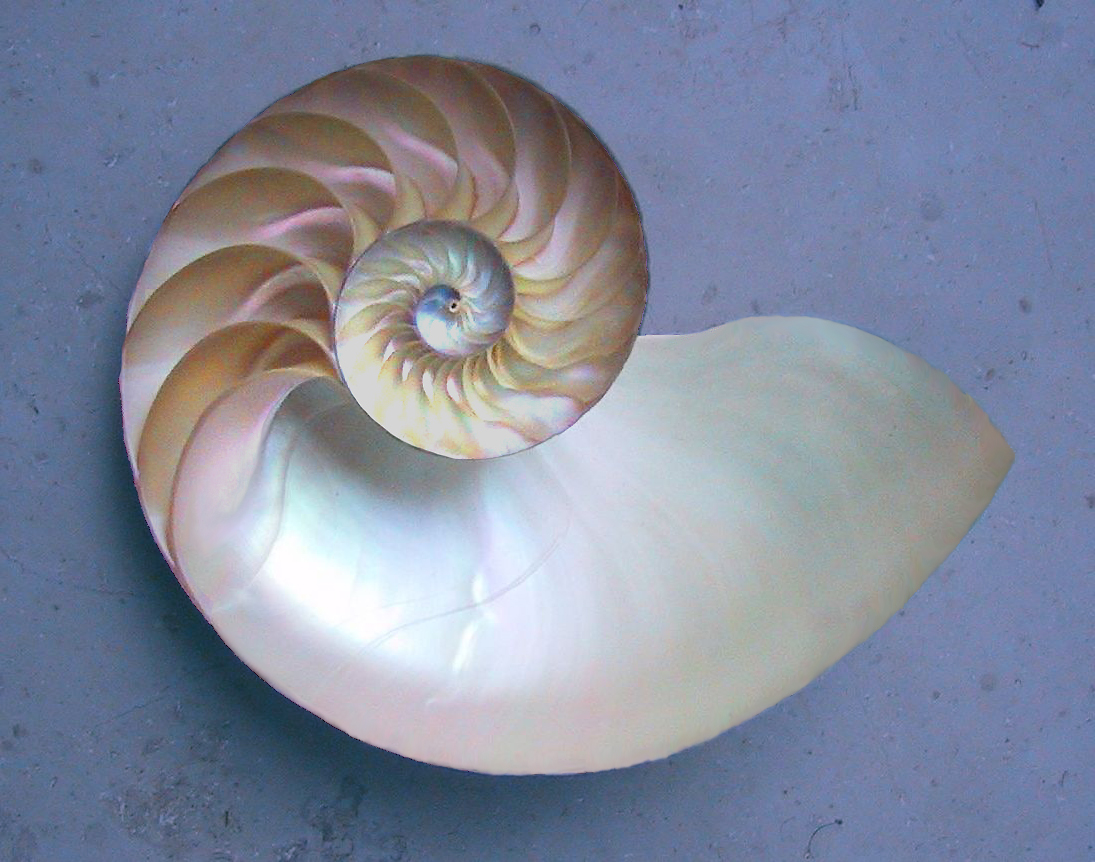
A mollusk shell grows by adding calcareous material at its opening. The mantle — soft tissue surrounding the mollusk's body — secretes this material continuously. The key to the spiral form lies in a simple constraint: the proportions of the cross-section remain constant during growth.
If the width of the opening grows proportionally to the current size of the shell, the result is a logarithmic spiral. This is the direct consequence of multiplicative growth — the same law governing compound interest or bacterial growth.
3. The differential equation
Proportional growth translates into a simple differential equation. If r is the shell radius and θ the angle, the proportional growth condition is written:
The solution to this equation is the logarithmic spiral:
where a is the initial radius and b the angular growth rate. The parameter b determines the spiral angle: .
This equation was formulated by D'Arcy Wentworth Thompson in his foundational work On Growth and Form (1917). Thompson showed that the logarithmic spiral is the inevitable form of any organism that grows proportionally to its current size while maintaining its shape.
4. Species-by-species parameters
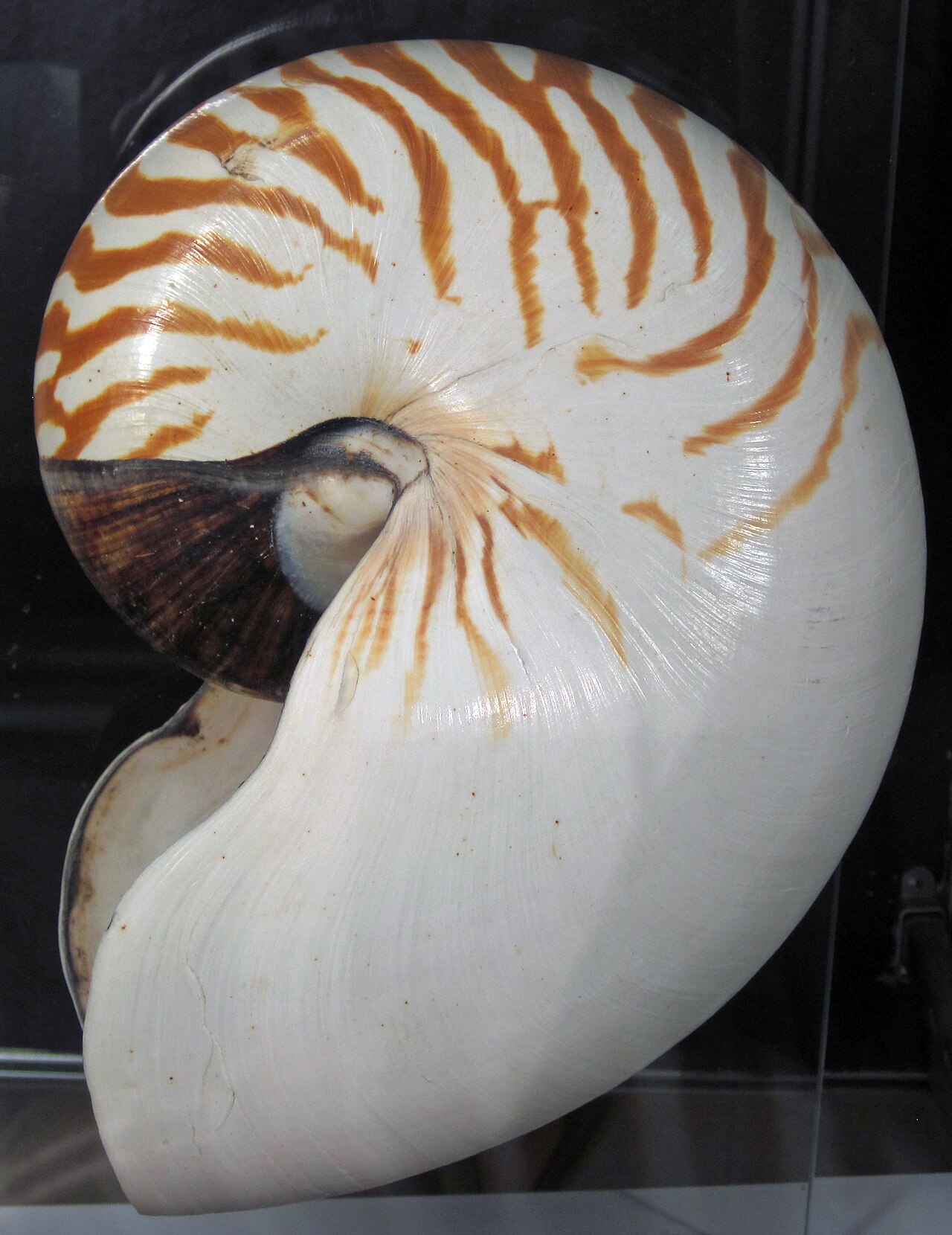
Each mollusk species has its own growth parameters. The spiral angle — the angle between the tangent to the curve and the radius — varies considerably from species to species.
- Nautilus (Nautilus pompilius): angle ≈ 17°, growth ratio ≈ 1.33 per half-turn
- Conch (Strombus gigas): angle ≈ 25°, faster growth
- Ammonite (Ammonites variabilis): angle ≈ 12–20° depending on species
- Burgundy snail (Helix pomatia): conical spiral, not planar
These variations reflect different ecological adaptations: a tighter shell is more mechanically resistant, a more open shell allows faster growth. Evolution has selected different parameters according to the constraints of each species.
5. The golden ratio myth
Popular belief holds that the nautilus shell is a perfect illustration of the golden ratio φ ≈ 1.618. This claim is inaccurate. The nautilus growth ratio per quarter turn is approximately 1.33, not 1.618.
Systematic studies have measured hundreds of nautilus shells and found no correspondence with φ. The growth ratio varies between 1.24 and 1.43 depending on individuals and populations — a natural variability that excludes any precise relationship with the golden ratio.
6. Conclusion
The nautilus shell is a logarithmic spiral — this is an established fact. But its parameters are determined by the biomechanics of growth and the evolutionary constraints of the species, not by a mysterious relationship with the golden ratio. Each mollusk species has its own parameters, reflecting its particular evolutionary history.
The beauty of the shell lies precisely in this mechanical explanation: a simple growth law — grow proportionally to current size — inevitably produces a form of remarkable mathematical elegance. No need to invoke a cosmic mystery.
The relation to the site’s thesis is precise: shell growth through translation of the aperture may share geometry, dynamics, or representation with another family of phenomena, but these levels are not identical. Comparison becomes scientific when it names the proposed shared mechanism, the variables that differ, and the test that could distinguish them.
The relation to the site’s thesis is precise: shell growth through translation of the aperture may share geometry, dynamics, or representation with another family of phenomena, but these levels are not identical. Comparison becomes scientific when it names the proposed shared mechanism, the variables that differ, and the test that could distinguish them.
The relation to the site’s thesis is precise: shell growth through translation of the aperture may share geometry, dynamics, or representation with another family of phenomena, but these levels are not identical. Comparison becomes scientific when it names the proposed shared mechanism, the variables that differ, and the test that could distinguish them.
The relation to the site’s thesis is precise: shell growth through translation of the aperture may share geometry, dynamics, or representation with another family of phenomena, but these levels are not identical. Comparison becomes scientific when it names the proposed shared mechanism, the variables that differ, and the test that could distinguish them.
The relation to the site’s thesis is precise: shell growth through translation of the aperture may share geometry, dynamics, or representation with another family of phenomena, but these levels are not identical. Comparison becomes scientific when it names the proposed shared mechanism, the variables that differ, and the test that could distinguish them.
Approaching the phenomenon without confusing image and mechanism
The concrete starting point is shell growth through translation of the aperture. A shell is not built by depositing an already drawn spiral. The mantle adds material at the aperture while the animal grows. If cross-section shape and enlargement rate remain approximately proportional, the global geometry can resemble a logarithmic spiral. This first distinction matters because a winding form can be a trajectory, a structure, a projection, or simply a graphical convention.
The model that makes comparison testable
Shell models use a scale factor, a rotation angle, axis translation, and sometimes changing cross-section. One photograph cannot identify these parameters separately. Fitting should compare several whorls and dimensions while distinguishing the geometric envelope from tissue growth. [1] The model is not the object: it is a description whose assumptions must remain visible.
An example, then its counter-example
The nautilus is a pedagogical example, not a universal golden-ratio standard. Related species can have different expansion rates; thickness, ribs, and deformation alter the silhouette. The resemblance to a classical spiral is real, but it summarizes one particular growth history. The counter-example is as instructive as the example: it shows which variable is missing when moving from one domain to another.
What can actually be measured
A useful study measures radius at equal angles, fits several laws, and publishes residuals. It also checks whether the apparent center stays fixed and whether the aperture keeps its proportions. These precautions turn a popular-science icon into a quantitative object without granting it unwarranted precision. A quantitative figure must distinguish published data, theoretical calculation, simulation, and conceptual diagram.
Decomposing variables instead of following the silhouette
To understand shell growth through translation of the aperture, separate at least the variable that rotates, the one that changes scale, and the one that transports information or matter. A shell is not built by depositing an already drawn spiral. The mantle adds material at the aperture while the animal grows. If cross-section shape and enlargement rate remain approximately proportional, the global geometry can resemble a logarithmic spiral. A global form can remain stable while its components are replaced; conversely, a trajectory can change shape without a new local mechanism.
The counter-example that protects the reasoning
Convergence with a mathematical spiral therefore comes from repeated growth and translation constraints. It does not mean that the mollusc “knows” the equation. The shape reveals a repeated local rule; it does not by itself reveal all the biology that makes it possible. We therefore cannot conclude from an image alone. We must ask which observation would falsify the hypothesis, then keep negative results in the comparison. This discipline is especially important when several models produce a similar outline.
A reproducible method
A useful study measures radius at equal angles, fits several laws, and publishes residuals. It also checks whether the apparent center stays fixed and whether the aperture keeps its proportions. These precautions turn a popular-science icon into a quantitative object without granting it unwarranted precision. To make the result checkable, preserve parameters, units, resolution, initial conditions, and calculation method. An interactive visualization should also provide a readable initial state and a reset control; otherwise readers see an output without understanding its dependencies.
Open questions
The model explains shell models use a scale factor, a rotation angle, axis translation, and sometimes changing cross-section. one photograph cannot identify these parameters separately. fitting should compare several whorls and dimensions while distinguishing the geometric envelope from tissue growth. [1] but does not answer questions at every scale. We still need to determine how initial conditions, perturbations, and system boundaries alter the pattern. This is where research begins: not by adding an analogy, but by formulating a prediction that could be measured.
Limits and scope of the analogy
Convergence with a mathematical spiral therefore comes from repeated growth and translation constraints. It does not mean that the mollusc “knows” the equation. The shape reveals a repeated local rule; it does not by itself reveal all the biology that makes it possible. [2]
Where the spiral is — and where it is not
The relation to the site’s thesis is precise: shell growth through translation of the aperture may share geometry, dynamics, or representation with another family of phenomena, but these levels are not identical. Comparison becomes scientific when it names the proposed shared mechanism, the variables that differ, and the test that could distinguish them.
References
- [1]Bernoulli, Jakob. (1691). Spira mirabilis. Acta Eruditorum
- [2]Vogel, Helmut. (1979). A Better Way to Construct the Sunflower Head. Mathematical Biosciences. DOI: 10.1016/0025-5564(79)90080-4