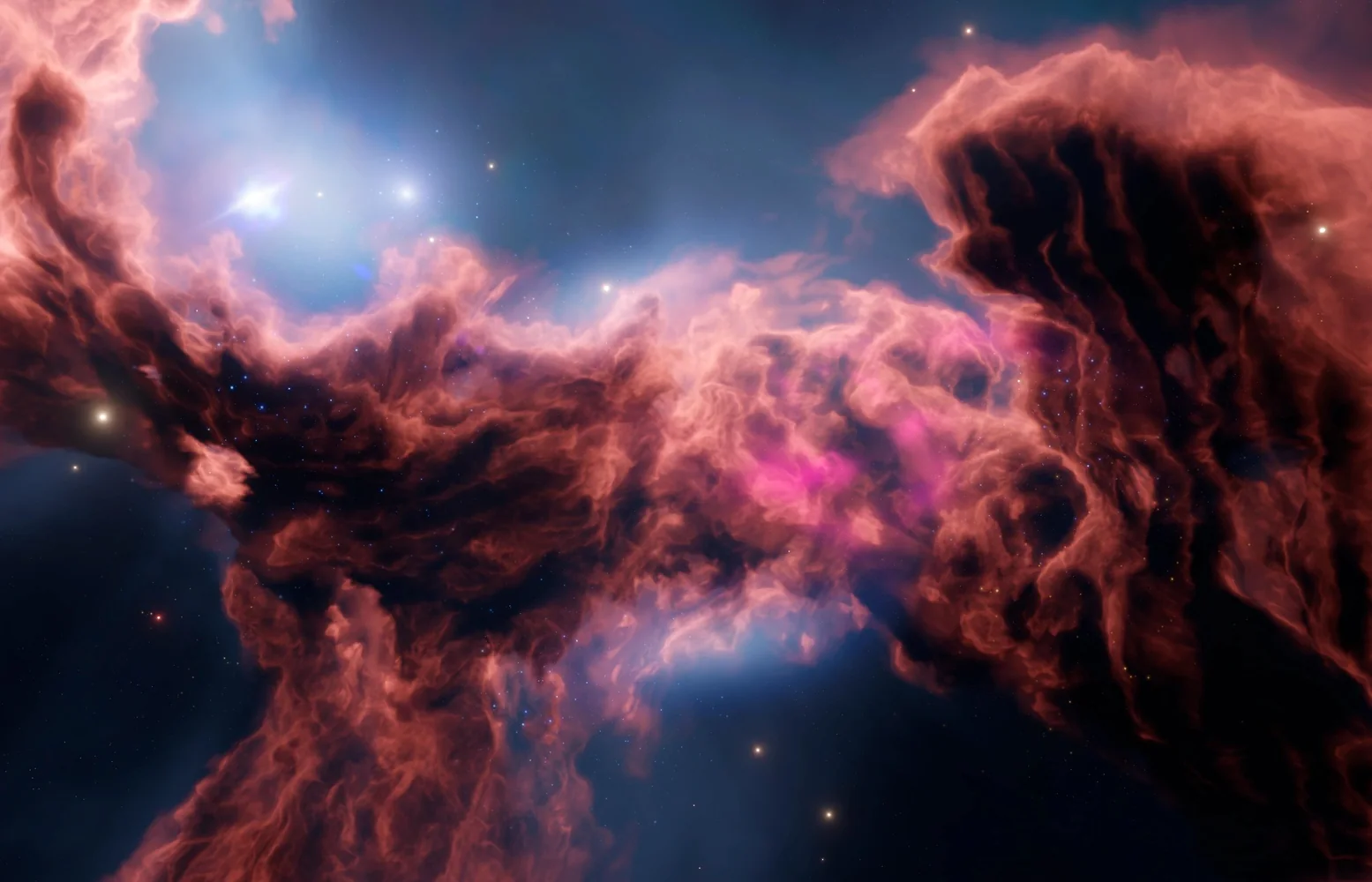
The solar system formed approximately 4.6 billion years ago from a dense region of a molecular cloud. Under the effect of gravity, matter contracted. Even a weak initial rotation becomes significant as the radius decreases, through conservation of angular momentum.
Matter therefore cannot fall entirely toward the center. Collisions dissipate disordered motions while preserving the overall rotation, which flattens the cloud into a disk around the protostar. This step explains why the major planetary orbits are approximately coplanar and oriented in the same direction.
Within the disk, dust grains collide and can aggregate. The transition from small grains to kilometer-sized bodies is complex, because collisions can also fragment particles or cause them to drift toward the star. Concentrations produced by turbulence and collective instabilities probably help to overcome this barrier.
Once planetesimals have formed, their gravity accelerates accretion. Planetary embryos appear, interact and migrate through the gas. Giant planets must accumulate a core and capture an envelope before the disk dissipates. Late collisions shape the terrestrial planets and can produce satellites.
Disks observed around young stars show rings, gaps, arcs and sometimes spiral arms. Some structures may be sculpted by nascent planets; others arise from instabilities, dust variations or radiative transfer effects. A spiral image is therefore not automatic proof of a planet.
The composition of the disk varies with temperature. Beyond certain condensation lines, ices can survive, increasing the amount of solid material available. The subsequent movements of the planets have, however, mixed the material, so that current positions do not tell the whole story.
The spiral appears mainly in density waves and in the trajectories of matter within the disk. The disk itself is a result of rotation and dissipation. Planet formation is a process of assembly, migration and reorganization, not a simple orderly march outward.
The relation to the site’s thesis is precise: gravitational collapse of a cloud and birth of a disk may share geometry, dynamics, or representation with another family of phenomena, but these levels are not identical. Comparison becomes scientific when it names the proposed shared mechanism, the variables that differ, and the test that could distinguish them.
The relation to the site’s thesis is precise: gravitational collapse of a cloud and birth of a disk may share geometry, dynamics, or representation with another family of phenomena, but these levels are not identical. Comparison becomes scientific when it names the proposed shared mechanism, the variables that differ, and the test that could distinguish them.
The relation to the site’s thesis is precise: gravitational collapse of a cloud and birth of a disk may share geometry, dynamics, or representation with another family of phenomena, but these levels are not identical. Comparison becomes scientific when it names the proposed shared mechanism, the variables that differ, and the test that could distinguish them.
The relation to the site’s thesis is precise: gravitational collapse of a cloud and birth of a disk may share geometry, dynamics, or representation with another family of phenomena, but these levels are not identical. Comparison becomes scientific when it names the proposed shared mechanism, the variables that differ, and the test that could distinguish them.
The relation to the site’s thesis is precise: gravitational collapse of a cloud and birth of a disk may share geometry, dynamics, or representation with another family of phenomena, but these levels are not identical. Comparison becomes scientific when it names the proposed shared mechanism, the variables that differ, and the test that could distinguish them.
Approaching the phenomenon without confusing image and mechanism
The concrete starting point is gravitational collapse of a cloud and birth of a disk. As a molecular cloud collapses, it approximately conserves angular momentum. As radial dimensions shrink, rotation becomes more important and matter gathers in a disk around the protostar. Any spiral is a structure in the gas, not one trajectory followed by every grain. This first distinction matters because a winding form can be a trajectory, a structure, a projection, or simply a graphical convention.
The model that makes comparison testable
The disk combines gravity, pressure, turbulence, viscosity, and heating. Temperature gradients alter chemistry and condensation zones; instabilities can produce arms or clumps. Planet formation then proceeds in an evolving environment, not a fixed geometry. [1] The model is not the object: it is a description whose assumptions must remain visible.
An example, then its counter-example
Grains settle, drift, and stick, while planetesimals gravitationally interact. A spiral pattern can concentrate gas or solids, but its effect depends on lifetime and particle response. A beautiful disk image must therefore be linked to times and sizes. The counter-example is as instructive as the example: it shows which variable is missing when moving from one domain to another.
What can actually be measured
A reconstruction distinguishes infrared observation, hydrodynamic simulation, and artist illustration. It states scale, represented temperature, and rotation direction only when known. Without this caption, colors and spirals risk becoming imaginary data. A quantitative figure must distinguish published data, theoretical calculation, simulation, and conceptual diagram.
Decomposing variables instead of following the silhouette
To understand gravitational collapse of a cloud and birth of a disk, separate at least the variable that rotates, the one that changes scale, and the one that transports information or matter. As a molecular cloud collapses, it approximately conserves angular momentum. As radial dimensions shrink, rotation becomes more important and matter gathers in a disk around the protostar. Any spiral is a structure in the gas, not one trajectory followed by every grain. A global form can remain stable while its components are replaced; conversely, a trajectory can change shape without a new local mechanism.
The counter-example that protects the reasoning
The spiral here connects angular-momentum conservation with collective instabilities. It is neither mandatory signature of planet formation nor a single cause. The model becomes interesting when it explains what is measured and what remains open. We therefore cannot conclude from an image alone. We must ask which observation would falsify the hypothesis, then keep negative results in the comparison. This discipline is especially important when several models produce a similar outline.
A reproducible method
A reconstruction distinguishes infrared observation, hydrodynamic simulation, and artist illustration. It states scale, represented temperature, and rotation direction only when known. Without this caption, colors and spirals risk becoming imaginary data. To make the result checkable, preserve parameters, units, resolution, initial conditions, and calculation method. An interactive visualization should also provide a readable initial state and a reset control; otherwise readers see an output without understanding its dependencies.
Open questions
The model explains the disk combines gravity, pressure, turbulence, viscosity, and heating. temperature gradients alter chemistry and condensation zones; instabilities can produce arms or clumps. planet formation then proceeds in an evolving environment, not a fixed geometry. [1] but does not answer questions at every scale. We still need to determine how initial conditions, perturbations, and system boundaries alter the pattern. This is where research begins: not by adding an analogy, but by formulating a prediction that could be measured.
Limits and scope of the analogy
The spiral here connects angular-momentum conservation with collective instabilities. It is neither mandatory signature of planet formation nor a single cause. The model becomes interesting when it explains what is measured and what remains open. [2]
Where the spiral is — and where it is not
The relation to the site’s thesis is precise: gravitational collapse of a cloud and birth of a disk may share geometry, dynamics, or representation with another family of phenomena, but these levels are not identical. Comparison becomes scientific when it names the proposed shared mechanism, the variables that differ, and the test that could distinguish them.
References
- [1]Toomre, Alar. (1964). On the Gravitational Stability of a Disk of Stars. The Astrophysical Journal. DOI: 10.1086/147861
- [2]Kepler, Johannes. (1619). Harmonices Mundi. Gottfried Tampach