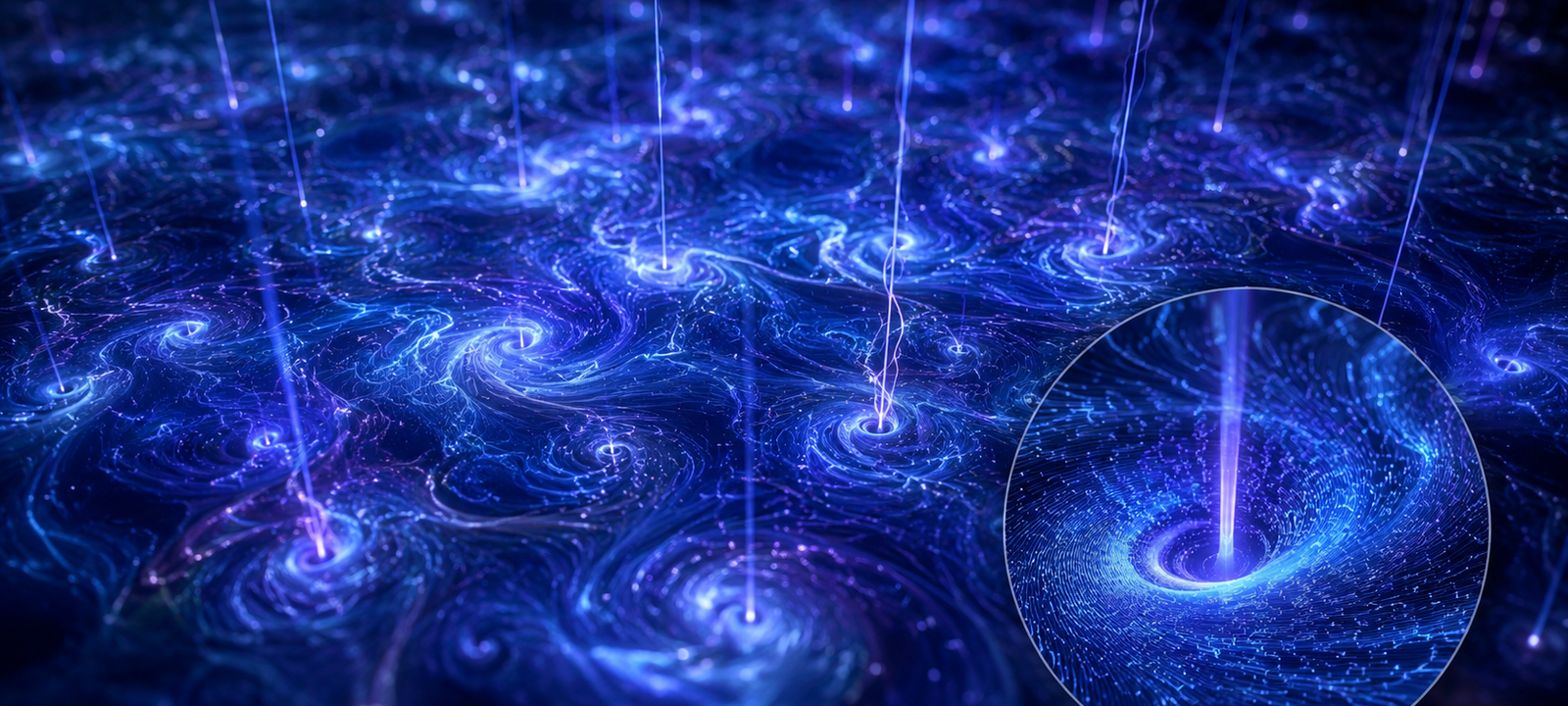
📎 Related article: Quantum Vortices: When Circulation Becomes Discrete — introduction to Abrikosov vortices and superconductivity.
1. Introduction
A quantum vortex is not a small material spiral visible to the naked eye. It is a topological structure in the order parameter field of a coherent quantum system — a superfluid, a superconductor, a Bose-Einstein condensate, or a superfluid Fermi gas. Its definition rests on the phase of the order parameter, not on the geometric shape of a flow.
The central question of this article is: what becomes of a quantum vortex when moving from a three-dimensional world, where it can be a filament, a line, or a ring, to a quasi-two-dimensional system, where it appears as a point around which the phase winds? This apparent simplification does not destroy the richness of the phenomenon — on the contrary, it reveals its essential topological structure.
2. What Is a Quantum Vortex?
In a superfluid or superconductor, particles are described by a coherent macroscopic wave function. This coherence imposes a strong constraint: the phase of the wave function must vary continuously in space, except at singular points. A quantum vortex is precisely one of these singular points: a topological defect around which the phase rotates by 2π (or an integer multiple of 2π).
The fundamental difference from a classical vortex is quantization: the circulation around a quantum vortex can only take discrete values, multiples of an elementary quantum. This quantization is a direct consequence of the wave nature of the wave function and the requirement of phase uniqueness.
3. The Complex Order Parameter
The order parameter of a superfluid or superconductor is a complex field ψ(r) that describes the macroscopic coherent state of the system. It can be written:
n: local superfluid density (|ψ|² = n); θ: phase of the order parameter, defined modulo 2π.
At the core of a vortex, the density n vanishes (or is strongly reduced) and the phase θ becomes undefined. This is the field singularity. Around the core, the phase varies from 0 to 2π going around the vortex, corresponding to a winding number equal to 1. A charge-n vortex carries a winding number n and n times larger circulation.
4. Quantized Circulation
The superfluid velocity is proportional to the phase gradient:
The integral of this velocity over a closed contour surrounding the vortex gives the circulation:
n: integer (winding number); h: Planck constant; m: mass of the superfluid particle. For helium-4: κ₀ = h/m ≈ 9.97 × 10⁻⁸ m²/s.
This quantization is a direct consequence of the requirement that the phase θ be a single-valued function: going around the vortex, θ must return to its initial value modulo 2π, which forces the circulation to be an integer multiple of h/m. Onsager (1949) [1] and Feynman (1955) [2] were the first to propose and analyze this quantization in superfluid helium.
5. The Topological Singularity
The term "topological singularity" here refers to a singularity of the phase field — a point (in 2D) or a line (in 3D) where the phase is undefined. It is not a gravitational singularity, nor a miniature black hole, nor a discontinuity in matter density. The superfluid density may vanish at the vortex core, but it remains finite and well-defined everywhere else.
The topological stability of the vortex is its most remarkable property: a charge-n vortex cannot disappear through a continuous deformation of the phase field. To eliminate it, one must either bring it to the boundary of the system, or annihilate it with an antivortex of charge −n. This stability is analogous to that of a knot in a rope: it cannot be undone without cutting the rope.
6. In Three Dimensions: Filaments, Rings, Networks, and Turbulence
In three dimensions, the core of a quantum vortex is a line — a filament. This filament can be straight, curved, or closed on itself as a ring. Vortex rings are particularly stable structures: they propagate in the direction perpendicular to their plane, driven by their own induction velocity. They were experimentally observed in superfluid helium by Tang et al. (2023) [3] by direct imaging.
Several filaments can become entangled, reconnect, and form complex networks. Quantum turbulence is a state in which a large number of vortex filaments are simultaneously present, with a statistical distribution of their orientations and lengths. Kelvin waves — helical oscillations along a filament — are a characteristic excitation mode of 3D quantum turbulence.
7. In Two Dimensions: Point Vortices, Antivortices, and the BKT Transition
In two dimensions (or in a sufficiently thin quasi-2D system), the vortex filament reduces to a point. This point is surrounded by a phase field that winds from 0 to 2π. An antivortex is a point around which the phase winds in the opposite direction (−2π). Vortices and antivortices can attract each other and mutually annihilate.
The Berezinskii-Kosterlitz-Thouless (BKT) transition [4] is a topological phase transition specific to 2D systems. Below a critical temperature T_BKT, vortices and antivortices are bound in neutral pairs (vortex-antivortex pairs). Above T_BKT, pairs dissociate and free vortices proliferate, destroying long-range order. This transition was experimentally observed in a trapped atomic gas by Hadzibabic et al. (2006) [5].
8. What Changes in the 3D → 2D Transition
- Geometry: the 3D filament becomes a 2D point; the 3D ring has no direct 2D equivalent.
- Degrees of freedom: in 3D, the filament can bend, vibrate (Kelvin waves), reconnect; in 2D, the point vortex can only translate.
- Interactions: in 3D, filaments interact via their velocity field along their entire length; in 2D, point vortices interact logarithmically with distance.
- Defect types: in 3D, linear defects (filaments) and surface defects (domain walls); in 2D, point defects (vortices) and linear defects (dislocations).
- Dissipation mechanisms: in 3D, filament reconnection and phonon emission; in 2D, vortex-antivortex pair annihilation.
- Pair dynamics: specific to 2D, the BKT transition has no 3D equivalent.
- Topology: in 3D, the classification group is π₁(S¹) = ℤ; in 2D, same group but the collective physics is radically different.
9. Vortices in Different Quantum Systems
Quantum vortices appear in all systems that possess a coherent complex order parameter. Experiments are conducted at extremely low temperatures — never exactly at absolute zero (0 K), which is an ideal theoretical limit that is inaccessible — but in very low temperature regimes: nanokelvin for atomic Bose-Einstein condensates, millikelvin for some helium systems.
- Superfluid helium-4: first system where quantized vortices were predicted (Onsager 1949, Feynman 1955) and observed. Superfluid transition temperature: 2.17 K.
- Atomic Bose-Einstein condensates: gases of atoms cooled to temperatures of the order of nanokelvin. Vortex lattice observed by Abo-Shaeer et al. (2001) [6].
- Superfluid Fermi gases: Cooper pairs of fermionic atoms. Vortices observed in ⁶Li and ⁴⁰K gases.
- Type-II superconductors: Abrikosov vortices carrying one quantum of magnetic flux Φ₀ = h/(2e).
- Polariton fluids: light-matter hybrid systems in semiconductor microcavities, at temperatures that can reach a few kelvins.
10. Giant Vortices and Clusters
A giant vortex is a vortex whose winding number n is greater than 1. It carries n circulation quanta and its core is n times wider than an elementary vortex. Giant vortices are generally unstable in homogeneous condensates — they fragment into n elementary vortices — but can be stabilized by appropriate confinement potentials. Švančara et al. (2024) [7] observed a stable giant vortex in superfluid helium.
Same-sign vortex clusters are collective structures observed in 2D quantum turbulence. Gauthier et al. (2019) [8] observed giant vortex clusters in a 2D quantum fluid, revealing rich collective dynamics with no direct 3D equivalent.
11. Recent Experiments
- Abo-Shaeer et al. (2001) [6]: first vortex lattice in a rotating Bose-Einstein condensate, observed by absorption imaging.
- Hadzibabic et al. (2006) [5]: experimental observation of the BKT crossover in a trapped 2D atomic gas.
- Bradley & Anderson (2012) [9]: theoretical and numerical study of 2D vortex distribution spectra, scaling laws.
- Gauthier et al. (2019) [8]: giant vortex clusters in a 2D quantum fluid, Science.
- Guthrie et al. (2021) [10]: real-time nanoscale detection of quantum vortices in superfluid helium, Nature Communications.
- Tang et al. (2023) [3]: direct imaging of quantized vortex rings in superfluid helium, Nature Communications.
- Švančara et al. (2024) [7]: stable giant quantum vortex in superfluid helium, Nature.
12. A Fractal Intuition (J.-F. Weemaes)
⚠️ What follows is a personal intuition of the author, Jean-François Weemaes, and not an established result of physics. It is presented as a visual and conceptual hypothesis, not as a scientific claim.
The repetitions of vortices and spirals at multiple scales — from giant vortices to elementary vortices, from lattices to clusters, from 3D filaments to 2D points — can evoke a fractal structure and give the impression that one can slide from the very large to the quantum domain. The transition from the 3D line to the 2D point seems to reveal a more fundamental form, almost reduced to its topology.
This analogy is fruitful for reflection, but it must be tempered by several important caveats:
- A visual resemblance between scales does not prove a common physical origin. Classical and quantum vortices obey fundamentally different equations.
- Not all vortex networks are mathematically fractal. A regular hexagonal lattice is not fractal.
- Some turbulences and scale cascades can however produce scaling laws, clusters, and hierarchical structures that evoke partial self-similarity.
- The vortex "singularity" is topological or phase-related, not cosmological. It implies no divergence of energy density.
- The 3D → 2D transition is a real physical dimension reduction, not a slide toward a more fundamental scale in the cosmological sense.
13. Conclusion
The quantum vortex is a topological structure whose richness lies not in its visible geometric form, but in the structure of the phase of the surrounding order parameter. In three dimensions, it is a filament or ring with complex dynamics — Kelvin waves, reconnections, turbulence. In two dimensions, it reduces to a point, but this reduction reveals deep collective physics: bound pairs, BKT transition, clusters, 2D turbulence.
The 3D → 2D transition does not impoverish the phenomenon: it reveals its essential topological structure. This is one of the clearest examples of how dimension reduction can, paradoxically, enrich our understanding of a physical phenomenon.
References
- [1]Onsager, L.. (1949). Statistical hydrodynamics. Nuovo Cimento (Supplemento), 6, p. 279–287. DOI: 10.1007/BF02780991
- [2]Feynman, R. P.. (1955). Application of quantum mechanics to liquid helium. Progress in Low Temperature Physics, 1, p. 17–53. DOI: 10.1016/S0079-6417(08)60077-3
- [3]Tang, Y., Bao, S., Guo, W. & Clark, B. K.. (2023). Imaging quantized vortex rings in superfluid helium to evaluate quantum dissipation. Nature Communications, 14, p. 2941. DOI: 10.1038/s41467-023-38601-7
- [4]Kosterlitz, J. M. & Thouless, D. J.. (1973). Ordering, metastability and phase transitions in two-dimensional systems. Journal of Physics C: Solid State Physics, 6(7), p. 1181–1203. DOI: 10.1088/0022-3719/6/7/010
- [5]Hadzibabic, Z., Krüger, P., Cheneau, M., Battelier, B. & Dalibard, J.. (2006). Berezinskii-Kosterlitz-Thouless crossover in a trapped atomic gas. Nature, 441(7097), p. 1118–1121. DOI: 10.1038/nature04851
- [6]Abo-Shaeer, J. R., Raman, C., Vogels, J. M. & Ketterle, W.. (2001). Observation of Vortex Lattices in Bose-Einstein Condensates. Science, 292(5516), p. 476–479. DOI: 10.1126/science.1060182
- [7]Švančara, P., Smolka, S., Paoletti, M. S. & La Mantia, M.. (2024). Stable giant quantum vortex in superfluid helium. Nature, 626, p. 74–79. DOI: 10.1038/s41586-023-06978-6
- [8]Gauthier, G., Reeves, M. T., Yu, X., Bradley, A. S., Baker, M. A., Bell, T. A., Rubinsztein-Dunlop, H., Davis, M. J. & Neely, T. W.. (2019). Giant vortex clusters in a two-dimensional quantum fluid. Science, 364(6447), p. 1264–1267. DOI: 10.1126/science.aat5718
- [9]Bradley, A. S. & Anderson, B. P.. (2012). Energy spectra of vortex distributions in two-dimensional quantum turbulence. Physical Review X, 2(4), p. 041001. DOI: 10.1103/PhysRevX.2.041001
- [10]Guthrie, A., Kafanov, S., Noble, M. T., Pashkin, Y. A., Pickett, G. R., Tsepelin, V., Dorofeev, A. A., Eltsov, V. B. & Haley, R. P.. (2021). Nanoscale real-time detection of quantum vortices at millikelvin temperatures. Nature Communications, 12, p. 2645. DOI: 10.1038/s41467-021-22909-3