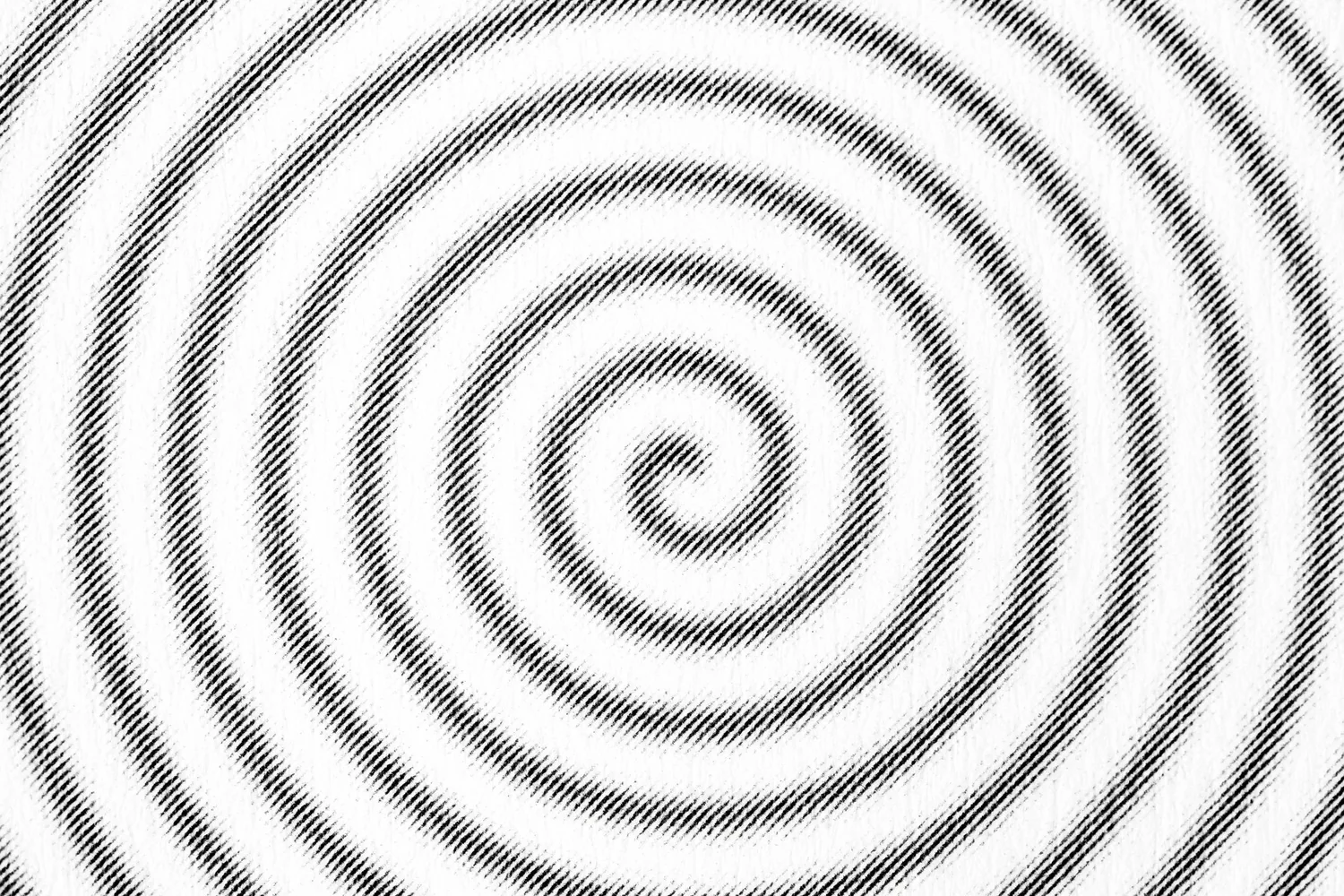
Introduction: a spiral that is not there
The Fraser spiral appears to wind toward the center.
Yet every major band closes onto itself.
The image contains concentric circles.
The spiral exists in perception, not in the coordinates.
Other static images seem to rotate, slide or breathe.
These effects reveal that vision is not passive recording.
The retina receives local contrast, partial contours and retinal motion.
The visual system estimates global shape, direction and stability.
An illusion occurs when an artificial pattern drives a normally useful perceptual computation toward a result that differs from the physical stimulus.
Physical and perceived geometry
Distinguish:
- file geometry;
- retinal image;
- perceived shape.
The file specifies exact circles, segments and luminances.
The retinal image depends on size, optics, eccentricity and eye movements.
The percept may contain curvature, tilt or rotation.
The difference can be measured by adding an opposite physical distortion until the pattern looks neutral.
Shape illusions and motion illusions
Shape illusions alter perceived orientation or curvature:
- Fraser;
- Zöllner;
- Café Wall.
Motion illusions add perceived velocity:
- Rotating Snakes;
- Fraser-Wilcox;
- Enigma;
- Ouchi;
- Pinna-Brelstaff during radial motion.
One display may combine both.
The Fraser spiral
Fraser’s 1908 twisted-cord illusion uses concentric rings built from oblique local elements. [1]
The local orientations differ from the true circle tangent.
Global integration produces a continuously deviating contour.
Because the pattern wraps around a center, the deviation appears spiral.
Tracing or recoloring one ring reveals closure.
A simple orientation-mixture model
Let the true contour tangent be:
and local element orientation be:
A pedagogical mixture is:
so:
This is not a complete neural model.
It demonstrates how a repeated local bias can accumulate into a global spiral percept.
Measuring apparent curvature
The interactive display should vary:
- local tilt;
- ring width;
- contrast;
- background;
- spatial frequency.
A compensating physical spiral:
can be adjusted until the rings appear circular.
The fitted b is a local, nonclinical estimate of illusion strength.
Reverse Fraser illusion
Yun and colleagues compared physical circles and spirals with parallel or twisted cords. [2]
Twisted cords could make circles look spiral and physical spirals look more circular.
The result shows a competition between global contour and internal orientation.
Zöllner illusion
Long parallel lines crossed by short oblique inducers appear nonparallel.
The effect depends on inducer angle, spacing, contrast and spatial scale.
Orientation interactions, grouping and depth context have all been investigated.
No single sentence should be presented as a complete explanation.
Café Wall illusion
Staggered dark and light tiles separated by intermediate mortar make parallel lines appear tilted.
Local contrast boundaries generate wedge-like orientation signals at certain spatial scales.
Mortar luminance strongly changes the effect.
Wrapping tilt into a spiral
Kitaoka, Pinna and Brelstaff showed that several tilt illusions produce spiral illusions when arranged as concentric rings.
A small tangential error repeated around a center becomes a global spiral percept.
Local-to-global integration
Early visual signals are local.
A spiral is global.
The brain integrates orientation, scale, position and continuity over large regions.
The illusion appears when local cues bias the global solution.
Orientation-selective receptive fields
Primary visual cortex contains neurons selective for edge orientation. [3]
Fraser patterns activate signals for both the circular contour and oblique internal elements.
Perception results from population activity and interaction across levels, not one detector.
Spatial filtering
High spatial frequencies represent fine segments.
Lower frequencies represent broad envelopes.
Blurring Café Wall reveals diagonal structure.
Changing scale in Fraser changes the balance between cord and carrier contour.
A software blur is only an analogy to biological filtering.
Gestalt grouping
Proximity, similarity, continuation and closure influence grouping.
Oblique segments may be grouped along an implied direction.
Gestalt principles describe perceptual regularities but are not a complete physiological account.
The aperture problem
A local detector viewing an edge can measure only motion normal to the edge.
Tangential motion remains ambiguous.
Global motion requires integration across orientations.
This principle is central to Pinna-Brelstaff.
Pinna-Brelstaff
Rings made of tilted elements rotate perceptually when the image expands or contracts.
The real motion is radial.
The perceived relative motion is tangential.
Reversing element orientation reverses the perceived rotation.
Repeated asymmetric patterns
Static motion illusions often use asymmetric luminance units.
A repeated sequence such as:
black → dark gray → white → light gray
may produce different response timing across neighboring elements.
The spatial order then resembles a temporal motion sequence.
Rotating Snakes
Rotating Snakes is physically stationary but often appears to rotate.
The effect is influenced by:
- luminance order;
- contrast;
- peripheral viewing;
- fixation changes;
- blinks;
- spatial scale.
Susceptibility varies.
Response latency model
A simplified response is:
Differences in tau across neighboring elements can create an apparent motion signal.
Real visual responses are more complex than this illustration.
Peripheral vision and eccentricity
The effect is often stronger away from direct fixation.
Peripheral receptive fields are larger and spatial-temporal integration differs from the fovea.
The stimulus must be scaled appropriately.
Microsaccades, drift and blinks
Fixation contains microsaccades, drift, tremor and blinks. [4]
These transients move or reset the retinal image.
Studies have reported relationships between eye transients and reported illusory rotation.
They are contributors, not a universally complete explanation.
Motion cortex
V1 supplies local direction signals.
MT+ integrates motion over larger regions.
Neurophysiology and fMRI show that static motion illusions recruit ordinary motion-processing networks.
Activation does not by itself prove a single causal origin.
Individual and age differences
Illusion strength varies with age, fixation, contrast sensitivity, scale, lighting and display.
A weak or absent effect is not a diagnosis.
Enigma and Ouchi
Enigma produces apparent flow in radial textures.
Ouchi produces relative sliding between center and surround under small retinal motion.
These examples show that “illusory motion” includes multiple computational problems.
Motion aftereffect
After viewing real motion, a stationary scene may move in the opposite direction.
This adaptation effect differs from direct anomalous motion in a static pattern.
Measuring illusion strength
Methods include:
- forced choice;
- rating;
- adjustment;
- motion cancellation;
- adaptive staircase.
A simple web experiment may estimate:
but it is not a clinical or published measurement.
Illusions as scientific tools
Illusions allow controlled perturbation of:
- luminance;
- orientation;
- eye movement;
- context;
- scale;
- attention.
They reveal dependencies that ordinary scenes hide.
Human and machine vision
Artificial models may reproduce some illusion-like outputs.
That does not imply shared mechanisms.
Models can also fail on human illusions or report illusions where humans see none.
A 2026 preprint found that most tested optical-flow models failed to produce human-like Rotating Snakes flow, while one human-inspired dual-channel model produced the expected direction under simulated saccades.
This must be labeled emerging research.
Interactive laboratory
The article should include:
1. Fraser Lab; 2. Tilt-to-Spiral converter; 3. Pinna-Brelstaff vector explorer; 4. Rotating Snakes luminance lab; 5. eye-transient simulator; 6. psychophysical motion cancellation; 7. human-versus-model comparison.
Where is the spiral?
The Fraser spiral is not physically present.
That is the point.
Local orientations, circular organization and global integration create a spiral percept.
In Rotating Snakes, static rings also appear to move.
Perceived form is not always measured form.
Perceived dynamics is not always physical motion.
Conclusion
Illusory spirals separate stimulus from percept.
They reveal orientation filtering, global integration, temporal response, eye movements and motion processing.
Different illusions use different combinations of these mechanisms.
Vision is an active estimate of the causes of retinal signals.
The spiral appears in that estimate.
References
- [1]Fraser, James. (1908). A New Visual Illusion of Direction. British Journal of Psychology, 2, p. 307–320. DOI: 10.1111/j.2044-8295.1908.tb00182.x. https://doi.org/10.1111/j.2044-8295.1908.tb00182.x
- [2]Yun, X.; Hazenberg, S. J.; Jacobs, R. H. A. H.; Qiu, J.; van Lier, R.. (2015). The Neural Signature of the Fraser Illusion: An Explorative EEG Study on Fraser-Like Displays. Frontiers in Human Neuroscience, 9, p. 374. DOI: 10.3389/fnhum.2015.00374. https://pubmed.ncbi.nlm.nih.gov/26190990/
- [3]Hubel, D. H.; Wiesel, T. N.. (1962). Receptive Fields, Binocular Interaction and Functional Architecture in the Cat’s Visual Cortex. The Journal of Physiology, 160, p. 106–154. DOI: 10.1113/jphysiol.1962.sp006837. https://doi.org/10.1113/jphysiol.1962.sp006837
- [4]Otero-Millan, J.; Macknik, S. L.; Martinez-Conde, S.. (2012). Microsaccades and Blinks Trigger Illusory Rotation in the “Rotating Snakes” Illusion. The Journal of Neuroscience, 32(17), p. 6043–6051. DOI: 10.1523/JNEUROSCI.5823-11.2012. https://pubmed.ncbi.nlm.nih.gov/22539864/