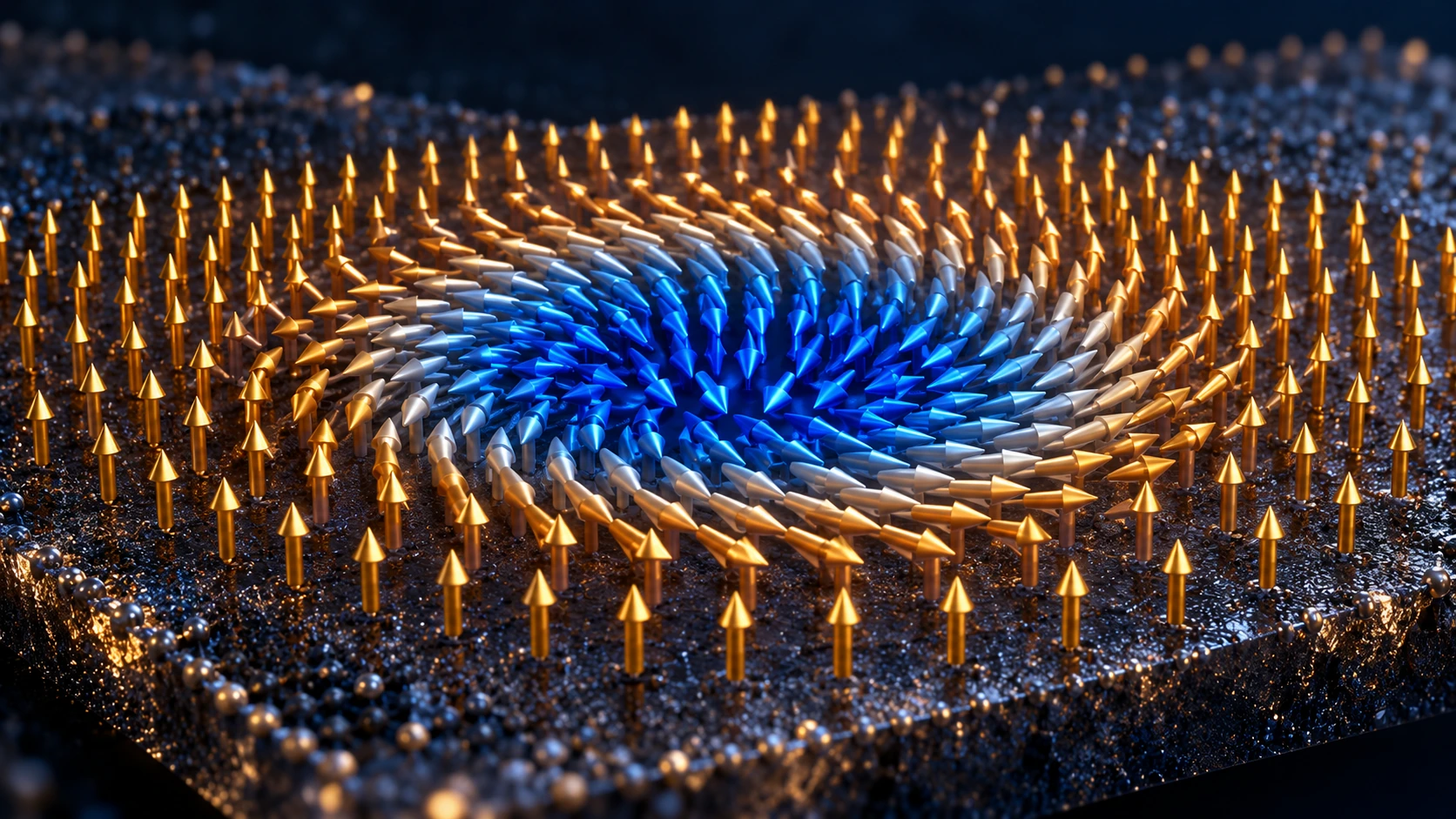
Research synthesis. The cover is an original artistic illustration; the diagrams are explanatory constructions, not microscope images.
1. The question: what can a shape protect?
An ordinary magnetic memory distinguishes orientations. A skyrmion asks a subtler question: can information reside in the way all orientations within a small region fit together? An isolated arrow cannot answer it. We must examine a vector field, its boundaries and its allowed transformations. The key move is from local magnetization to collective topology. That move does not remove thermal noise, material defects or the cost of reading the state.
Fert, Reyren and Cros review magnetic skyrmions as topological textures and candidates for information manipulation, separating stabilization, dynamics and potential applications. Potential matters: a physical possibility is not yet an industrial technology. [1]
2. Texture, vortex and spiral: three descriptions
Let m(x,y) be normalized local magnetization, with |m| = 1. In a top view, color can encode its vertical component and short lines its horizontal projection. The drawing does not show particles traveling along a spiral road. It shows directions attached to positions. Following those lines visually may suggest rotation, but that is not a measurement of material transport. A stationary texture can already carry nonzero topological charge.
This expression separates three often-confused parameters. The profile θ describes tilting from core to background. Integer n counts azimuthal winding. Helicity χ sets the in-plane orientation and is not itself the topological number. Our example uses θ(0) = π and θ(R) = 0: core down, background up. The linear profile is chosen to explain the calculation, not to minimize the energy of a real material. R is arbitrary; plotted distances are divided by R.
3. Calculate charge instead of recognizing a silhouette
The triple product measures an oriented area swept on the sphere of directions. Integrating over the film adds those small areas; 4π is the area of the unit sphere. For a smooth texture with a uniformly fixed boundary, the plane can be compactified into a sphere and Q becomes an integer degree. The fixed-boundary condition matters: a texture can escape through a sample edge without following the same energetic route as disappearance inside the film. Topological protection is not independent of sample geometry.
Polar coordinates make the derivation transparent. The area element supplies r, canceling the angular derivative’s 1/r. What remains is the integral of n θ′ sin θ. Since the derivative of cos θ is −θ′ sin θ, only the endpoint angles survive. With n = 1 our convention gives Q = −1. Reversing core polarity or changing conventions can reverse the sign; comparing papers requires definitions, not just two numbers.
4. Néel and Bloch: change appearance without changing Q
For χ = 0, our texture’s in-plane projection is radial: Néel type. For χ = π/2 it becomes tangential: Bloch type. Appearance changes substantially while θ and n remain unchanged, so Q is unchanged. This thought experiment shows why a swirling image is insufficient to establish topology. It also shows that one number cannot describe all physics: textures sharing Q can differ in energy, interfacial coupling and response to current.
5. Stability comes from competing energy terms
Each term expresses a preference rather than a separate decision. Exchange A penalizes rapid variation; anisotropy Kᵤ favors selected directions; an external field selects polarity. Dipolar interactions depend on the whole magnetization distribution. In chiral systems, the Dzyaloshinskii–Moriya interaction can favor a handed rotation. Its form depends on material and interface symmetries, so one universal expression would mislead. Stability is a compromise, and a metastable solution can be useful without being the global minimum.
Real-space imaging of a two-dimensional skyrmion crystal by Yu and colleagues in 2010 linked calculated textures to microscopic contrast. An instrument still does not directly deliver every component of m perfectly at every point. Identification requires a contrast model, experimental conditions and, ideally, complementary controls. [2]
6. Motion need not follow the force
In this rigid-texture approximation, the gyrotropic term rotates the response while dissipation opposes motion. The general lesson is that a longitudinal force can produce transverse displacement. G’s sign convention must be specified; the robust feature illustrated here is reversed deflection when charge changes sign. Our segments show directions, not experimentally extracted trajectories. Absolute speed would require device parameters and a force law.
Time-resolved X-ray microscopy by Litzius and colleagues revealed the Hall effect and dynamics beyond a perfectly rigid object. In a wire, edges, pinning and deformation can alter the response. Claiming that charge determines the entire trajectory would exceed this collective-coordinate description. [3]
7. Protection is not immortality
An energy barrier implies a waiting time, not a magical prohibition. Under thermal activation, adding a few kᵦT to ΔE strongly multiplies the characteristic lifetime. A mechanism that locally lowers the barrier can instead make a texture fragile. The graph shows only τ/τ₀: without a characteristic attempt time, temperature and measured barrier, claims of years of retention would be unjustified. The approximation assumes rare activation and a dominant escape route; strong pulses can invalidate it.
8. From simple skyrmions to nested structures
Liu and colleagues reported room-temperature creation and conversion of skyrmion bags in multilayer disks in 2025, including zero-field stable states. Confinement contributes to stability. This is a result for a particular platform, not a guarantee for arbitrary stacks. [4]
The schematic rule Q = N − 1 counts N interior structures of polarity opposite to their envelope under the corresponding convention. N = 1 can therefore yield Q = 0 without a uniform texture. Zero total charge does not imply absence of structure. Like a sum of opposite numbers, a configuration may have zero total and rich internal organization. Manipulation still requires knowing whether its parts remain bound, how they deform and what a sensor actually detects.
Wu and colleagues published work in June 2026 on current-induced creation and dynamics of embedded magnetic skyrmion bags. This adds electrical control to the structural question. Our perspective is that the next useful comparison should combine creation, transport and reading in one error-and-energy budget; that is an editorial inference, not a reported result of their paper. [5]
9. Read a bit without conflating Hall effects
An electrical signal does not arrive labeled with its cause. Ordinary, anomalous and potentially topological contributions can coexist. Maccariello and colleagues electrically detected individual skyrmions in room-temperature multilayers; in their system the signal was predominantly anomalous Hall, with negligible topological contribution. Electrical detection and detection through the topological Hall effect are therefore not synonyms. [6]
A credible memory must repeatedly perform four operations. Writing requires a known probability of creating the desired state. Moving requires control of edge losses and position spread. Reading requires statistically distinguishable signals without destroying the state. Repetition requires material aging not to silently change those probabilities. An exceptional single-object experiment may establish a mechanism; a device must also quantify failures. That difference separates a proof of principle from a technological promise.
10. How to reproduce and question the diagrams
To reproduce the charge calculation, sample θ(r) = π(1 − r/R), set n = 1 and integrate analytically before discretizing. Check Q(0) = 0 and Q(R) = −1. Then reduce the grid spacing: a result that changes strongly when the spacing is halved is not converged. At the center φ is undefined but the vector has a defined limit; naively differentiating the angle can create a false defect. Working with vectors or discrete solid angles is safer.
The same method guides evaluation of future announcements: ask what components were measured, what reconstruction was used, what boundaries applied, how long observation lasted and how often operations failed. Separate observed object count from calculated charge, and charge from lifetime. The central claim of this synthesis is demanding but simple: a skyrmion’s scientific value lies less in its attractive shape than in a verifiable link among collective geometry, dynamics and independent measurement.
11. Worked calculation: size, charge and reading error
Consider textures of radii R and 2R with the same reduced profile θ(r/R). Spatial derivatives in the larger one are halved, so topological density is quartered while integration area quadruples. Q is unchanged. Enlarging a picture therefore creates no additional charge. Energy need not remain unchanged: energetic terms scale differently with size and boundaries can matter.
For reading, assume equally probable Gaussian signal distributions with means −μ and +μ and common standard deviation σ. A zero threshold gives error probability Φ(−μ/σ), with Φ the normal cumulative distribution. Separation is controlled by μ/σ, not charge alone. This thought experiment estimates no device’s error rate, but motivates measuring distributions, their stability and non-Gaussian tails rather than displaying two distinct means.
12. Experiments that would change the conclusion
A convincing robustness test would compare charges under controlled geometry and pulses while measuring losses and energy cost. Stability tests would examine multiple temperatures without fitting one slope across changing escape mechanisms. Miniaturization tests would examine whether charge estimation and the continuum model remain valid as atomic spacing becomes relevant. Such experiments could narrow a promise or strengthen it; either outcome provides more knowledge than a texture catalogue.
References
- [1]Albert Fert; Nicolas Reyren; Vincent Cros. (2017). Magnetic skyrmions: advances in physics and potential applications. Nature Reviews Materials. DOI: 10.1038/natrevmats.2017.31. https://www.nature.com/articles/natrevmats201731
- [2]X. Z. Yu et al.. (2010). Real-space observation of a two-dimensional skyrmion crystal. Nature. DOI: 10.1038/nature09124. https://www.nature.com/articles/nature09124
- [3]Kai Litzius et al.. (2017). Skyrmion Hall effect revealed by direct time-resolved X-ray microscopy. Nature Physics. DOI: 10.1038/nphys4000. https://www.nature.com/articles/nphys4000
- [4]Quan Liu et al.. (2025). Room-temperature creation and conversion of individual skyrmion bags in magnetic multilayered disks. Nature Communications. DOI: 10.1038/s41467-024-55489-z. https://www.nature.com/articles/s41467-024-55489-z
- [5]Y. Wu; J. Jiang; L. Kong et al.. (2026). Current-induced creation and dynamics of embedded magnetic skyrmion bags. Nature Communications. DOI: 10.1038/s41467-026-74046-4. https://www.nature.com/articles/s41467-026-74046-4
- [6]Davide Maccariello et al.. (2018). Electrical detection of single magnetic skyrmions in metallic multilayers at room temperature. Nature Nanotechnology. DOI: 10.1038/s41565-017-0044-4. https://www.nature.com/articles/s41565-017-0044-4