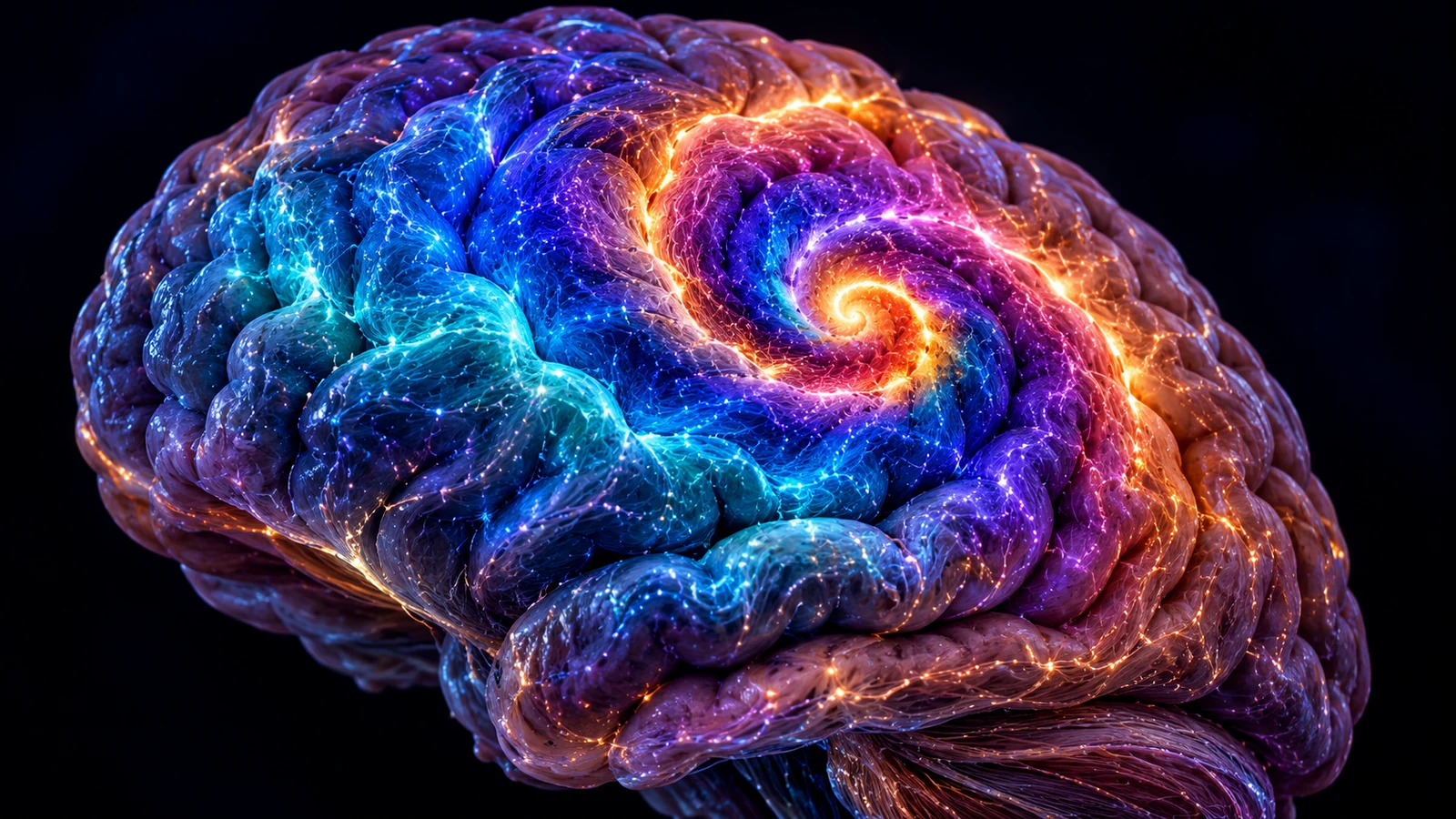
1. Introduction — A brain wave is not just a line
Brain waves are often drawn as lines moving up and down across a screen. That representation is useful, but it hides an essential dimension: the brain extends through space. Two cortical regions may oscillate at nearly the same frequency while remaining out of phase, and that phase difference can itself move.
When we stop examining one electrode at a time and reconstruct activity as a spatiotemporal field, some oscillations no longer look like independent sinusoids. They become traveling waves. Some are nearly planar. Others expand from sources, contract into sinks, form saddles — and some rotate around a singular point.
That last case is a spiral wave.
This is more than an attractive visualization. Between 2023 and 2026, studies using high-density EEG, intracranial ECoG, large-scale voltage imaging and electrophysiology strengthened the case that rotating waves are recurring patterns of brain activity. They appear during sleep, during memory tasks and across sensorimotor cortical networks. In 2026, a mouse study even connected their geometry with a measurable circular axonal architecture.
The interesting question is therefore no longer simply, “Does the brain make spirals?”
It is:
2. From \(V(t)\) to \(V(\mathbf r,t)\)
At position (\mathbf r), a local oscillatory signal can be idealized as
Frequency tells us how rapidly the cycle repeats. Amplitude (A) tells us its strength. But for traveling waves, the crucial variable is often phase (\phi).
A spatially varying phase creates a phase gradient:
Using the Hilbert transform, one can form an analytic signal
Applied over many locations, this converts a collection of time series into a complex field.
3. The singularity: where phase stops being defined

Around a closed contour (C) surrounding a spiral core,
Elementary spirals commonly have (q=+1) or (q=-1), corresponding to opposite winding directions.
At the exact center, no single phase can be assigned. For the complex field (Z=Ae^{i\phi}) to remain well behaved, the amplitude must become very small near the core:
The 2025 high-density EEG study observed a strong reduction in normalized signal amplitude near detected spiral centers. The apparent hole is not merely a graphical flourish; it is tied to the very definition of a phase singularity.
4. N2 sleep: 256 electrodes and tens of thousands of spirals
Xu and colleagues analyzed high-density EEG from nine participants with obstructive sleep apnea. Of 256 electrodes, 166 above the ears were used to reconstruct two-dimensional cortical maps.
They focused on N2 sleep spindles in the
range.
After phase extraction and phase-velocity-field analysis, the authors identified plane waves, sources, sinks, saddles and spirals.
About 40% of phase-velocity fields during spindle epochs were organized as spirals around phase singularities. After conservative filtering, 36,212 spiral epochs were analyzed, with an average lifetime of approximately
A phase-randomized null model and minimum size/duration rules were used to avoid accepting patterns merely because they looked circular.
5. The spiral can rotate while its center moves
The detected core is not necessarily fixed. Some spiral centers travel over long cortical distances; others remain comparatively local.
This produces two superimposed dynamics:
- phase rotates around the center;
- the center itself moves.
A brain spiral is therefore not a wheel bolted to cortex. It is better thought of as rotation organized around a mobile defect in the phase field.
6. From scalp EEG to cortical sources
Scalp EEG is affected by volume conduction through brain tissue, cerebrospinal fluid, skull and soft tissue. A sensor-level spiral could therefore be suspected of being a projection artifact.
The 2025 study also performed source-level reconstruction and reported spiral structures consistent with the sensor-level patterns. This does not give EEG millimeter precision; it strengthens the claim that the observed organization is not a trivial artifact of electrode placement.
7. Memory and age: fascinating result, tiny sample

Long-term trajectory consistency was positively correlated with overnight memory retention:
Consistency also decreased with age in this sample.
But the methodological label matters: nine male participants, around 50 years old on average, all with moderate-to-severe obstructive sleep apnea, tested before and after CPAP therapy.
Box — Nine brains do not make a law of nature
The finding deserves attention. It does not justify a validated clinical biomarker.
Larger, more diverse cohorts, independent replications and prospective validation are required.
8. 2026: spirals also appear during awake human memory
In April 2026, Das, Zabeh, Ermentrout and Jacobs published direct human brain recordings from memory tasks. Their framework allowed a broader family of traveling-wave geometries:
- planar;
- rotational/spiral;
- source-like;
- sink-like;
- concentric;
- complex.
Wave geometry and strength varied with specific behavioral states, and some patterns distinguished specific remembered items.
This does not mean “one spiral equals one memory.” The stronger conclusion is that spatiotemporal wave configuration carries information about ongoing cortical processing.
9. June 18, 2026: the spiral meets the wiring
A 2026 Science study in mice linked rotating cortical waves to anatomical structure.
Rotating waves frequently emerged in somatosensory cortex, where local axonal projections displayed a matching circular organization. The waves were coordinated between hemispheres, between sensory and motor regions, and with activity in deeper structures including thalamus, striatum and midbrain.
A small air puff to the left whiskers could evoke clockwise rotating waves in right sensory cortex with corresponding motor-cortex activity.
This creates a plausible mechanistic chain:
Functional proposals such as a “space-and-time clock” for sensation and action remain hypotheses rather than universal conclusions.
10. Detecting a spiral without eyeballing it
From the phase field, one can construct a phase-velocity field and local vorticity:
Localized high vorticity helps identify rotating patterns. Practical detection must also handle phase wrapping, interpolation, grid boundaries, noise, volume conduction and temporal core tracking.
Topology can be robust. Measurement is not automatically robust.
11. Brain, heart, superfluid: same syntax, different systems
See also: Cardiac Spiral Waves: How Electrical Reentry Sustains Arrhythmia and From Filament to Point: Quantum Vortices Across 3D, 2D, and Topological Singularity.
The heart supports reentrant spiral waves in an excitable medium.
A quantum vortex is a defect in a coherent order parameter
A reconstructed cortical oscillatory field can be written
All can involve winding:
But their substrates, equations of motion and physical meanings differ dramatically.
12. What is known, suspected and unknown
Observed
- Spiral waves occur in several brain measurement modalities and states.
- Human N2 spindles can frequently form large-scale spirals.
- Spiral centers can move.
- In a small EEG sample, trajectory consistency correlated with memory retention and age.
- Human intracranial rotational waves vary with memory-task state.
- In mice, some rotating waves match circular axonal architecture and participate in broad sensorimotor coordination.
Plausible but not universally demonstrated
- Spirals may organize temporal sequencing across distant regions.
- Wave geometry may help select communication routes.
- Some trajectory features could eventually become useful biomarkers.
Unknown
- How broadly these findings generalize to healthy, diverse human populations.
- Whether targeted manipulation of a spiral would causally alter memory or cognition.
- How spirals measured at different scales and with different technologies map onto one another.
- Whether one unified traveling-wave theory can connect sleep, perception, memory and action without erasing mechanism-specific differences.
13. Conclusion — When phase becomes geography
A brain wave is not only a frequency. It also has a position, direction and phase relationship with neighboring regions.
Once those dimensions are taken seriously, cortical activity acquires a geography: waves can travel, converge, diverge and rotate.
Across human sleep spirals, intracranial memory waves and circular sensory circuits in mice, a hypothesis is becoming increasingly concrete: the spatiotemporal form of neural activity may be a functional variable rather than mere background structure.
Much remains to be demonstrated. But once the brain is reconstructed as a dynamic field rather than a stack of traces, some of its most interesting structures have a center around which phase completes a full turn.
For once, saying that the brain is “going in circles” may be technically defensible — provided you have enough electrodes and define your terms.