1. Introduction
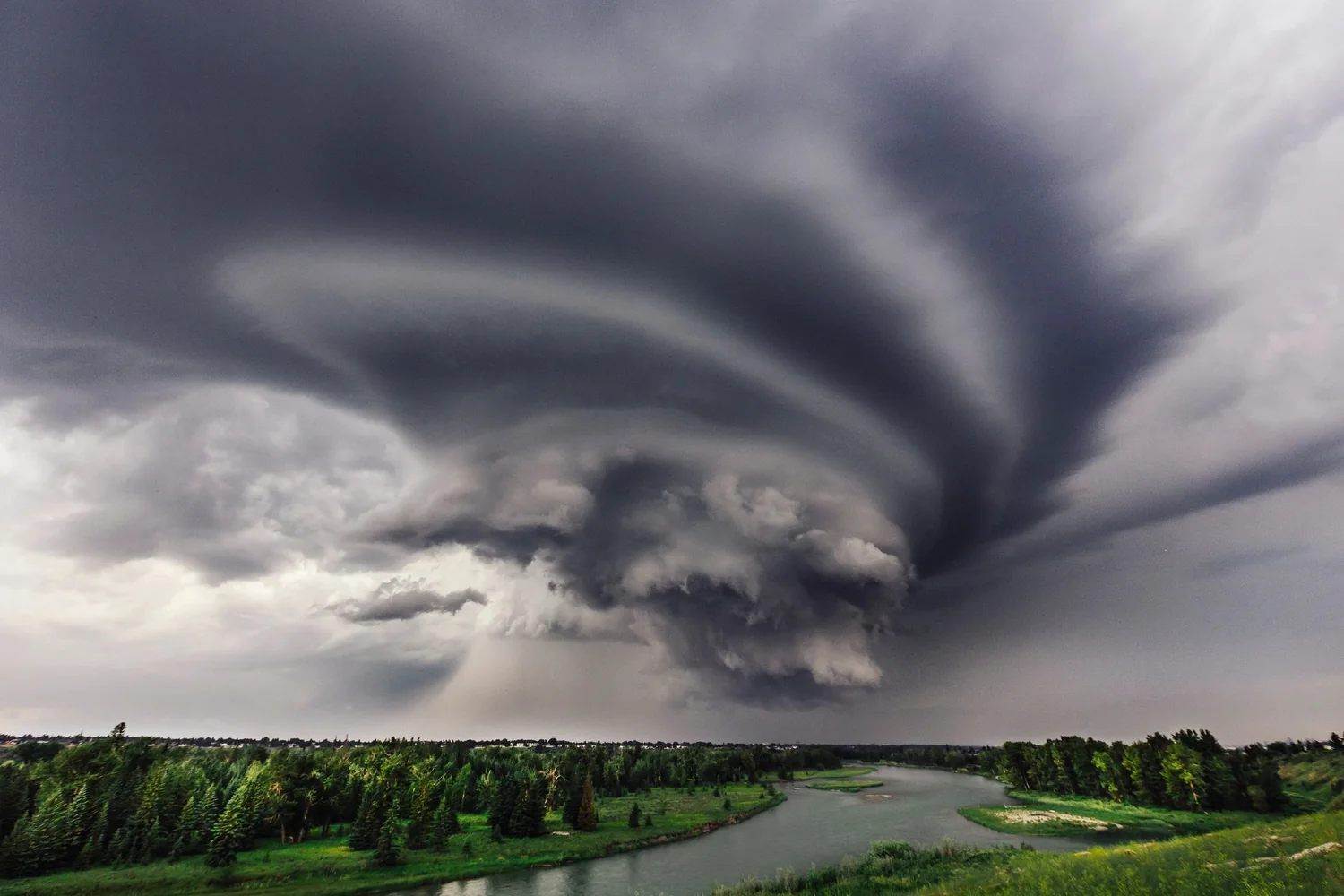
A tornado is an intense atmospheric vortex in contact with the ground and the base of a cumulonimbus cloud. Its spiral structure is one of the most spectacular manifestations of atmospheric fluid dynamics. The most intense tornadoes can reach wind speeds exceeding 500 km/h.
2. Tornado Formation
The most violent tornadoes form in supercells — organized rotating thunderstorms. Rotation begins in the storm's mesosphere, several kilometers up, when wind shear (variation of speed and direction with altitude) generates horizontal rotation that is then tilted to vertical by the storm's updrafts. This rotation progressively descends to the ground.
3. Internal Structure of a Tornado
A mature tornado has a Burgers vortex structure: a central core in quasi-solid rotation surrounded by a potential-flow region. The pressure at the center is 10 to 20% below ambient pressure, sucking air and debris upward. The most intense tornadoes can have multiple secondary vortices orbiting around the main vortex.
4. Enhanced Fujita Scale (EF)
- EF0: 105-137 km/h, light damage
- EF1: 138-177 km/h, moderate damage
- EF2: 178-217 km/h, considerable damage
- EF3: 218-266 km/h, severe damage
- EF4: 267-322 km/h, devastating damage
- EF5: >322 km/h, incredible damage
5. Conclusion
A tornado is an atmospheric vortex whose spiral structure results from conservation of angular momentum in a converging fluid. Its formation requires very specific atmospheric conditions — wind shear, convective instability, humidity — which explains why intense tornadoes are concentrated in certain geographic regions.
The relation to the site’s thesis is precise: an intense flow coupling pressure, rotation, and convection may share geometry, dynamics, or representation with another family of phenomena, but these levels are not identical. Comparison becomes scientific when it names the proposed shared mechanism, the variables that differ, and the test that could distinguish them.
The relation to the site’s thesis is precise: an intense flow coupling pressure, rotation, and convection may share geometry, dynamics, or representation with another family of phenomena, but these levels are not identical. Comparison becomes scientific when it names the proposed shared mechanism, the variables that differ, and the test that could distinguish them.
The relation to the site’s thesis is precise: an intense flow coupling pressure, rotation, and convection may share geometry, dynamics, or representation with another family of phenomena, but these levels are not identical. Comparison becomes scientific when it names the proposed shared mechanism, the variables that differ, and the test that could distinguish them.
The relation to the site’s thesis is precise: an intense flow coupling pressure, rotation, and convection may share geometry, dynamics, or representation with another family of phenomena, but these levels are not identical. Comparison becomes scientific when it names the proposed shared mechanism, the variables that differ, and the test that could distinguish them.
The relation to the site’s thesis is precise: an intense flow coupling pressure, rotation, and convection may share geometry, dynamics, or representation with another family of phenomena, but these levels are not identical. Comparison becomes scientific when it names the proposed shared mechanism, the variables that differ, and the test that could distinguish them.
Approaching the phenomenon without confusing image and mechanism
The concrete starting point is an intense flow coupling pressure, rotation, and convection. A tornado is a rotating air column associated with circulation and an updraft. Pressure drops toward the core, but visible shape also depends on condensation, humidity, and lighting. The funnel cloud is not a solid boundary or a direct photograph of the whole vortex. This first distinction matters because a winding form can be a trajectory, a structure, a projection, or simply a graphical convention.
The model that makes comparison testable
Navier–Stokes equations couple velocity, pressure, viscosity, and forces. In a simple approximation, angular-momentum conservation explains why moving toward the axis can accelerate rotation. This intuition does not replace three-dimensional dynamics, turbulence, and ground interaction. The model is not the object: it is a description whose assumptions must remain visible.
An example, then its counter-example
Sink vortices, cyclones, and tornadoes share words but not scales or balances. Coriolis force matters for large-scale cyclones but is not a sufficient explanation for an individual tornado. Comparison requires naming dominant terms. The counter-example is as instructive as the example: it shows which variable is missing when moving from one domain to another.
What can actually be measured
A study combines radar, video, anemometers, and numerical models. It separates tangential, radial, and vertical velocity, then reports spatial uncertainty. A simple winding arrow is a circulation diagram, not a wind measurement. A quantitative figure must distinguish published data, theoretical calculation, simulation, and conceptual diagram.
Decomposing variables instead of following the silhouette
To understand an intense flow coupling pressure, rotation, and convection, separate at least the variable that rotates, the one that changes scale, and the one that transports information or matter. A tornado is a rotating air column associated with circulation and an updraft. Pressure drops toward the core, but visible shape also depends on condensation, humidity, and lighting. The funnel cloud is not a solid boundary or a direct photograph of the whole vortex. A global form can remain stable while its components are replaced; conversely, a trajectory can change shape without a new local mechanism.
The counter-example that protects the reasoning
A tornado naturally connects spiral and converging flow, but the analogy must remain local. The mechanism is a velocity field under atmospheric constraints; visible shape is a partial and variable consequence of that field. We therefore cannot conclude from an image alone. We must ask which observation would falsify the hypothesis, then keep negative results in the comparison. This discipline is especially important when several models produce a similar outline.
A reproducible method
A study combines radar, video, anemometers, and numerical models. It separates tangential, radial, and vertical velocity, then reports spatial uncertainty. A simple winding arrow is a circulation diagram, not a wind measurement. To make the result checkable, preserve parameters, units, resolution, initial conditions, and calculation method. An interactive visualization should also provide a readable initial state and a reset control; otherwise readers see an output without understanding its dependencies.
Open questions
The model explains navier–stokes equations couple velocity, pressure, viscosity, and forces. in a simple approximation, angular-momentum conservation explains why moving toward the axis can accelerate rotation. this intuition does not replace three-dimensional dynamics, turbulence, and ground interaction. but does not answer questions at every scale. We still need to determine how initial conditions, perturbations, and system boundaries alter the pattern. This is where research begins: not by adding an analogy, but by formulating a prediction that could be measured.
Limits and scope of the analogy
A tornado naturally connects spiral and converging flow, but the analogy must remain local. The mechanism is a velocity field under atmospheric constraints; visible shape is a partial and variable consequence of that field. [1]
Where the spiral is — and where it is not
The relation to the site’s thesis is precise: an intense flow coupling pressure, rotation, and convection may share geometry, dynamics, or representation with another family of phenomena, but these levels are not identical. Comparison becomes scientific when it names the proposed shared mechanism, the variables that differ, and the test that could distinguish them.
References
- [1]Kepler, Johannes. (1619). Harmonices Mundi. Gottfried Tampach