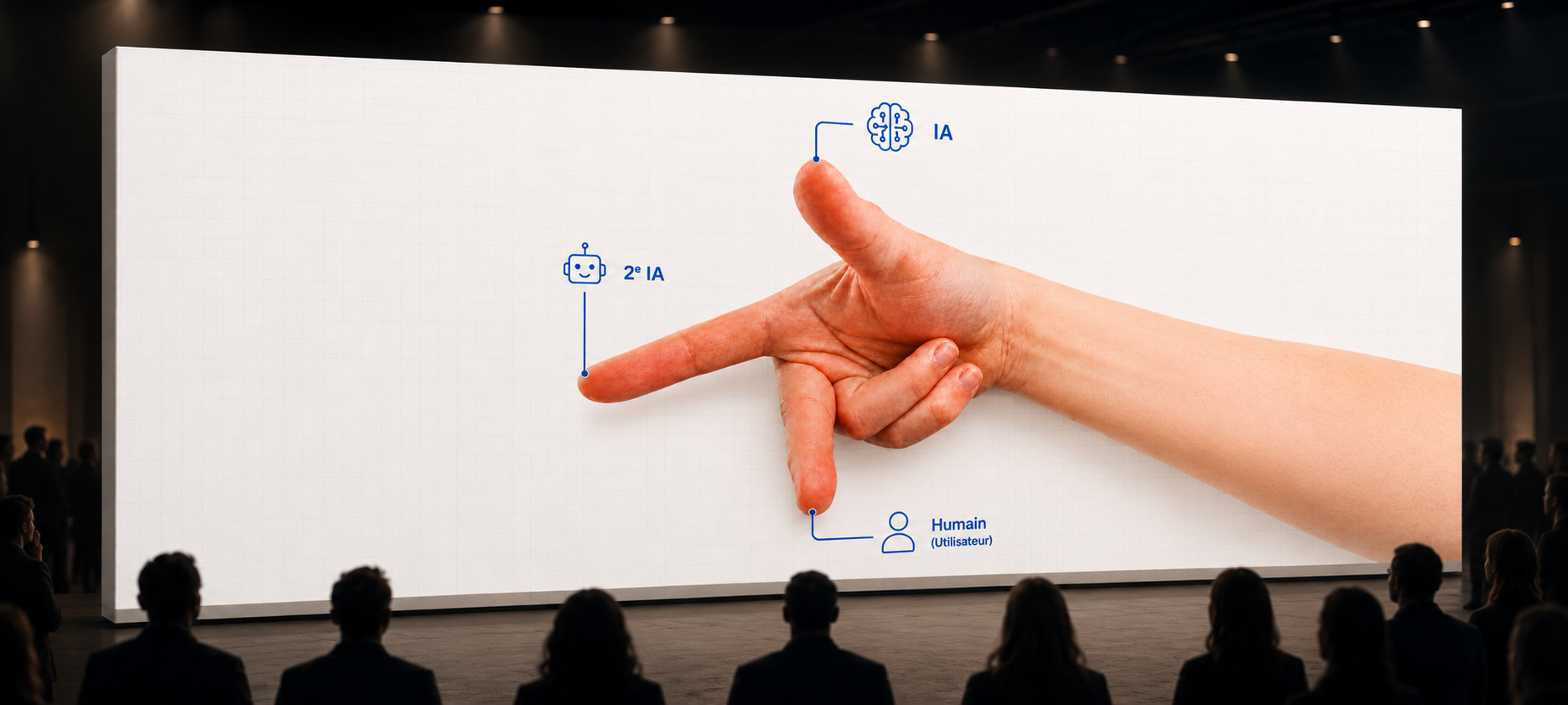
1. Why Use Two AIs?
Building a bilingual scientific website — with dozens of articles, server-side rendering, multilingual routes, complete SEO metadata, and a secured contact form — is a complex task. A single AI can technically execute each of these tasks. But no current AI simultaneously possesses three things: the global strategic vision of the project, precise knowledge of its current state, and the specialized tools to intervene directly in the execution environment.
This is precisely the observation that led to this proof of concept (PoC): making two AIs from two different companies cooperate under the direction of a single human. ChatGPT from OpenAI plays the role of the generalist AI. Airo AI Builder from GoDaddy plays the role of the specialist AI. Jean-François Weemaes, the author, directs the whole and retains intention, authority, and final responsibility.
⚠️ This proof of concept does not yet constitute an official partnership, joint product, or formal agreement between OpenAI and GoDaddy. However, it concretely explores several mechanisms through which two AI systems from two different companies can cooperate. The experiments have included communication through the OpenAI API, as well as orchestration through DOM and Web-interface interactions, allowing a general-purpose AI and Airo AI Builder to exchange objectives, results, reports, and corrections. The entire process remains under direct human supervision. The human defines the intent, controls the actions, monitors costs, verifies the results, stops unproductive or unsafe behavior, and retains final authority before any modification or publication. The project remains at the proof-of-concept stage. If the PoC demonstrates that this cooperation can be reliable, secure, traceable, and economically viable, the next step will be to discuss with GoDaddy and OpenAI the technical, commercial, legal, and ethical conditions required for a possible official cooperation.
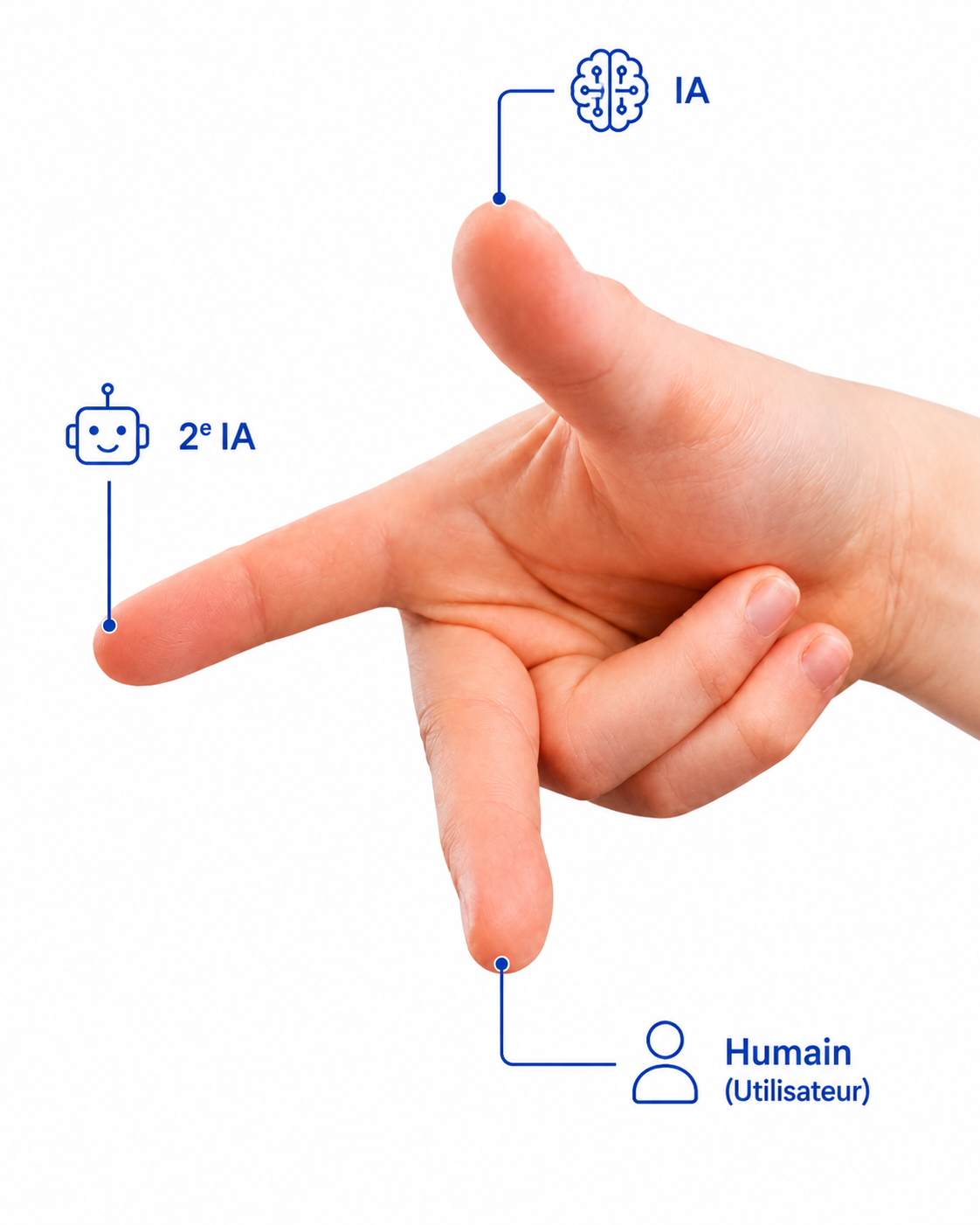
2. The Three Actors of the Model
The model rests on three distinct actors, each with a precise and non-interchangeable role. The human user defines the objective and makes all important decisions. The generalist AI analyzes, structures, and prepares instructions. The specialist AI executes technical changes in the project. These three actors do not replace each other: they complement each other.
3. The Generalist AI: ChatGPT
ChatGPT acts as a generalist AI. Its role is not to write code directly in the project, nor to deploy anything. Its role is to understand the human need in all its complexity, to analyze the problem from multiple angles, to structure objectives clearly, and to prepare detailed instructions that the specialist AI can execute without ambiguity.
Concretely, ChatGPT can help to: understand a vaguely expressed need and reformulate it precisely; identify the risks of a modification before it is executed; spot inconsistencies in a request; prepare a structured mandate with verifiable success criteria; analyze an error report and propose a targeted correction; maintain a global vision of the project across multiple sessions.
In this PoC, ChatGPT does not directly control GoDaddy infrastructure. It has no access to project files, cannot execute a build, and cannot publish the site. It works only with text — analyses, plans, mandates — that the human then transmits to the specialist AI.
4. The Specialist AI: Airo AI Builder
Airo AI Builder acts as the specialist AI for the Web project hosted at GoDaddy. Unlike the generalist, Airo directly knows its technical environment: it can read project files, modify TypeScript and React code, manage site components, execute the build, produce a real-time preview, verify HTTP routes, and prepare or perform production deployment.
Airo has tools that ChatGPT does not: direct access to the project file system, the ability to execute commands, verify endpoints, read server logs, and interact with GoDaddy infrastructure. This specialization is what makes it indispensable for technical execution.
On the other hand, Airo does not have the global strategic vision of the project. It works on what it is asked, within the limits of the current session. If the request is poorly formulated, it may execute something technically correct but that does not match the real intention. This is why the preparation of the mandate by the generalist is so important.
5. The Irreplaceable Role of the Human
The human is not a simple intermediary who copy-pastes messages between two systems. Their role is much more central. They are first the owner of intention: they know why the project exists, what it must accomplish, and what constitutes success. This intention cannot be delegated to an AI, because it is tied to values, constraints, and objectives that only the human knows completely.
The human is also the holder of real context. They know what was done in previous sessions, what worked, what failed, and why. They are the approval authority: no modification is published without their explicit validation. They are the cost controller: each intervention by the two AIs has a real cost, and it is the human who decides whether that cost is justified. They are finally the legal and ethical responsible party for published content.
- Owner of intention: defines why the project exists and what constitutes success
- Holder of real context: knows the complete history of sessions and decisions
- Approval authority: validates each modification before publication
- Cost controller: decides whether each intervention is justified
- Trajectory corrector: detects drifts and corrects them before they worsen
- Legal and ethical responsible party: assumes responsibility for published content
6. How the Three Actors Cooperate in Practice
In this PoC, several cooperation mechanisms were experimented between ChatGPT and Airo AI Builder. The experiments included communication via the OpenAI API, as well as orchestration through DOM and Web-interface interactions, allowing the two systems to exchange objectives, results, reports, and corrections. In all cases, the human remains at the center of the process: they supervise each information transfer, verify each step, and retain final authority over any action or publication.
The cooperation cycle unfolds in eight distinct and repeatable steps:
- The human formulates their intention: they describe what they want to accomplish, the constraints to respect, and the success criteria.
- ChatGPT analyzes the request: it identifies risks, ambiguities, and dependencies, then proposes a structure.
- The human prepares the mandate: they formulate a precise command for Airo, based on ChatGPT's analysis.
- Airo executes the changes: it modifies project files in the GoDaddy environment.
- Airo produces a preview or report: it shows the result and confirms verified routes.
- The human inspects the result: they verify quality, images, routes, article order, and costs.
- ChatGPT can help analyze errors: if something is wrong, it helps prepare a targeted correction.
- The human decides what to do next: continue, correct, stop, or publish.
Viewing the Cycle as a Discrete System
This mechanism can be made more concrete with an idea from discrete mathematics: instead of imagining a vague, continuous collaboration, represent it with a small number of named states. At any moment, the project is in one precise state; an allowed action moves it to the next state. The drawing does not describe a real AI in every detail: it makes the transitions that must be controlled visible.
S denotes the set of possible states in the cycle. The arrows in the sketch show permitted transitions; they prevent intent, execution, and evidence of success from being confused.
7. A Real Example in a Web Project
Here is a concrete example, drawn directly from this PoC. The human wants to add a new bilingual article to their scientific site without damaging the 58 articles already published. This is a task that seems simple, but carries several real risks: accidentally modifying the existing catalog, changing the article order, breaking a route, introducing a TypeScript error, or publishing without validation.
The human begins by explaining the need to ChatGPT. ChatGPT helps prepare a structured mandate that contains: the article subject and its bilingual titles; the desired position in the catalog; the files authorized to create or modify; the files that must not be touched; the validation criteria (clean TypeScript, HTTP 200 routes, no existing article modified); the explicit prohibition on automatic publication.
Airo then receives this mandate, creates the article content file, adds it to the catalog, verifies the routes, and produces a preview. The human then verifies: the quality of the text in both languages; the images; the French and English routes; the order of articles in the catalog; any TypeScript errors; the costs incurred; compliance with the initial intention. If everything is correct, the human approves and requests publication. Otherwise, they formulate a targeted correction and the cycle begins again.
This example illustrates why both AIs are useful together. ChatGPT helped anticipate risks and structure the request. Airo executed the changes precisely in its environment. The human verified and approved. None of the three actors could have produced this result alone with the same quality and safety.
8. The Generalist + Specialist Pattern
The "Generalist + Specialist" pattern is a cooperation architecture in which two AI systems play complementary roles. This is not new in computing: the separation between planning and execution is a fundamental principle of software engineering. What is new here is the application of this principle to two AIs from two different companies, coordinated by an individual human.
A generalist AI is useful for understanding a broad problem, connecting multiple domains, anticipating risks, and preparing a strategy. It excels at understanding natural language, synthesizing information, and formulating clear instructions. A specialist AI is useful for intervening effectively in a precise environment with adapted tools. It excels at technical execution, result verification, and infrastructure interaction.
The combination of both potentially allows for better overall understanding of the problem, more specialized and precise execution, a clear separation of responsibilities, human validation between steps, reduced interpretation errors, and better traceability of decisions. But this combination is not automatically beneficial. Poorly controlled cooperation can also cause unnecessary repetitions, contradictory requests, context loss, unwanted modifications, additional costs, and cycles where systems spin without progressing.
9. The Cooperation Contract
To prevent the two systems from working unnecessarily or drifting from the original request, each mandate transmitted from the generalist to the specialist (via the human) must take the form of an explicit cooperation contract. This contract is not a formal document: it is a communication structure that ensures both AIs and the human share the same understanding of what must be done, how, and how far.
The Cooperation Contract
| Element | What it must contain |
|---|---|
| Exact objective | What the specialist must produce, precisely and without ambiguity |
| Available context | Current project state, existing files, architecture, previous sessions |
| Responsibilities | What each actor must do and must not do in this session |
| Authorized files | Exact list of files the specialist may create or modify |
| Protected files | List of files that must not be touched, under any circumstances |
| Maximum cost | Maximum number of modified files or authorized actions in this session |
| Mandatory tests | Verifications the specialist must perform before declaring the task complete |
| Expected proof | What the specialist must provide as verifiable proof of success |
| Stop condition | When to stop and produce a report rather than continuing to iterate |
| Required approval | Explicit confirmation that no publication can occur without human validation |
10. Errors and Risks Observed
The main difficulties observed in this PoC are not only technical. They also concern context continuity, command precision, and cost management. Here are the most frequent risks, with their cause and concrete impact.
- Unnecessary repetition: the specialist redoes already completed work because the mandate did not specify what already existed. Real cost without added value.
- Context loss: after a long session, the specialist loses track of the existing architecture and rebuilds components that are already present.
- Request drift: the specialist interprets the request more broadly than intended and modifies files that should not have been touched.
- Status ambiguity: the human cannot tell whether an action succeeded or failed because the specialist's report is incomplete or ambiguous.
- Premature execution: the specialist starts coding before understanding the main constraint, requiring undoing and redoing.
- Absence of verifiable proof: the specialist claims success without providing concrete proof (URL, HTTP code, clean TypeScript).
- Full rebuild instead of targeted correction: faced with an error, the specialist rebuilds everything instead of correcting only what is wrong.
- Unanticipated cumulative costs: each unnecessary iteration consumes real resources, and costs accumulate quickly if the cycle is not controlled.
11. Necessary Safeguards
These risks are not inevitable. They can be significantly reduced by structural safeguards that the human puts in place before each session. These safeguards are not bureaucratic constraints: they are tools that allow cooperation to function reliably and economically.
- Project manifest: a reference document describing the exact project state, updated after each session. The specialist can consult it to avoid rebuilding what already exists.
- Restore point: a Git commit created before any modification, enabling immediate rollback if something goes wrong.
- Before/after comparison: systematically verify that existing articles have not been modified after each session.
- Explicit list of authorized files: each mandate specifies exactly which files may be created or modified.
- Targeted test before full test: verify a single route or component before verifying the entire site.
- Immediate stop on duplicate or anomaly: if a slug already exists or an anomaly is detected, stop and report rather than continue.
- No publication without explicit validation: no deployment without human approval, ever.
- Readable technical report: each session ends with a concise report listing modified files, verified routes, and proof of success.
Deciding from Evidence
A second discrete idea is a decision gate: several conditions must be true at the same time before approval can be requested. In practice, this means an attractive preview is not enough; planned tests and readable evidence must also be present. If a condition is missing, the visible path leads to a targeted correction, not to automatic publication.
The symbol ∧ means “and.” One missing condition is enough to stop the chain: the result must be corrected or documented before any approval is requested.
12. What the PoC Already Demonstrates
This PoC produced a concrete and measurable result: a bilingual scientific website with 59 articles, fully functional, with server-side rendering, multilingual routes, complete SEO metadata, a secured contact form, and production deployment on a custom domain. This result was produced in a few weeks by a single human assisted by two AIs.
The PoC demonstrates that: structured cooperation between two AIs from two different companies is technically feasible; the Generalist + Specialist pattern produces better quality results than a single AI used alone; the cooperation contract significantly reduces errors and unnecessary costs; the human at the center of the process is a necessity, not a limitation.
13. What Remains to Be Tested
This PoC is a feasibility demonstration, not a complete solution. Several important questions remain open. The experiments covered several cooperation mechanisms: communication via the OpenAI API, orchestration through DOM and Web-interface interactions. These approaches helped reduce the manual transfer burden, but raise new questions about security, traceability, and cost control. A standardized protocol or shared mandate format would allow going further.
Other aspects remain to be explored: conflict management between the two AIs when they have contradictory recommendations; context continuity on very long-term projects; objective measurement of the quality of the result produced by cooperation; and cost reduction through better anticipation of needs.
14. What Could Be Discussed with GoDaddy
GoDaddy is not a simple third conversational agent in this model. GoDaddy represents both the company, the infrastructure, and the technical environment in which the specialist AI works. It is GoDaddy that provides Airo AI Builder, hosting, domain, publication services, security mechanisms, and deployment tools. Without this infrastructure, the PoC could not have existed.
After the PoC tests, a discussion with GoDaddy could cover several topics. This is not to claim that such an agreement already exists or is imminent. It is to present the PoC results as a basis for reflection on what might be possible.
- An official method of cooperation between an external generalist AI and Airo AI Builder: permissions, authentication, standardized mandate format.
- Privacy: what data is transmitted between the two systems, and how to protect it.
- Security: how to ensure the generalist cannot inject malicious code via its mandates.
- Cost limits: how to define and control the maximum cost of a cooperation session.
- Action traceability: how to audit each decision made by each system.
- Restore points: how to guarantee that a rollback is always possible.
- Technical reports: how to produce reports readable by the human and verifiable.
- Human control: how to guarantee that the human always remains at the center of the process.
- Respective responsibilities: who is responsible if the specialist executes an incorrect mandate provided by the generalist.
- Stop mechanisms: how to stop unnecessary execution quickly and without loss.
- Possible business models: how such cooperation could be offered as a service.
15. Conclusion
Two AIs from two different companies can cooperate to produce a result that neither could produce alone with the same quality and efficiency. But this cooperation is not automatic, nor free, nor without risk. It requires a human who understands the capabilities and limits of each system, who formulates precise mandates, who verifies results at each step, and who assumes final responsibility.
This PoC is a demonstration that it is possible. The concrete result — this bilingual scientific website with 59 articles — is the proof. It is not yet a turnkey solution. It is the beginning of a reflection on what a structured, secure, and economically viable cooperation between AI systems from different companies, under human supervision, could look like.