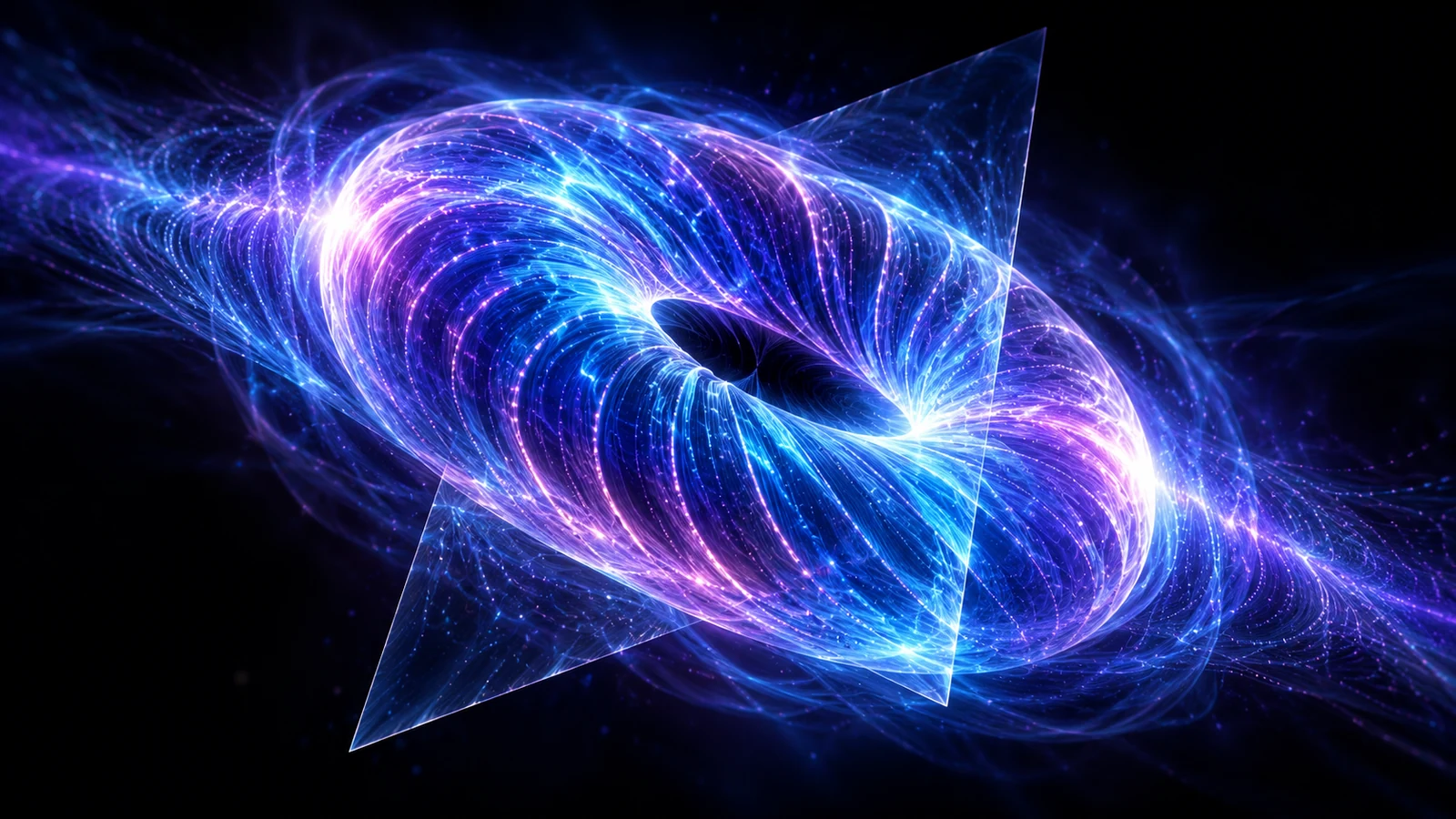
1. Introduction — There is more than one way to make light “rotate”
Saying that light rotates is dangerously ambiguous.
In circular polarization, the electric-field orientation rotates in the transverse plane.
In a conventional spatial optical vortex, the field phase winds around the propagation axis:
In a spatiotemporal optical vortex (STOV), the singularity is defined in a plane mixing a spatial coordinate with the local time of the pulse:
That changes the geometry of orbital angular momentum. The OAM can become transverse to the direction of propagation.
The topology of the light pulse is therefore structured in space and time.
2. Three rotations, three physical objects
For the broader electromagnetic context, see also Circular Polarization: When the Electric Field Rotates.
For circular polarization,
For a spatial vortex,
Its OAM is predominantly longitudinal:
A simplified STOV can be represented as
where
Then
The associated orbital-angular-momentum direction can be transverse:
3. Why a camera cannot simply photograph the whole STOV
The relevant structure lives in the complex envelope
A conventional camera does not resolve the femtosecond evolution of the pulse directly. Experiments therefore use interferometric reconstruction: a delayed reference pulse interferes with the signal, the delay is scanned, fringes are recorded and the spatiotemporal amplitude and phase are reconstructed.
As with spiral brain waves, the spiral becomes meaningful when a field is reconstructed rather than when one isolated measurement is inspected.
4. 2024: a slanted nanograting creates the vortex

Huo and colleagues demonstrated a compact silicon slanted-nanograting platform.
Breaking (C_2) and (z)-mirror symmetries creates an isolated zero in the complex transmission response
Around that zero, phase winds.
A Fourier transform maps the frequency–momentum structure into the spatiotemporal domain:
Thus,
5. The real device: 80 femtoseconds, 800 nanometers, about 42%


The experiment used pulses of approximately
centered around
The signal passes through the nanograting, while a reference arm supplies a controlled temporal delay. Interference fringes are recorded on a CCD.
The measured average STOV-generation efficiency was approximately
6. The experimental signature: a fork in the fringes

As the reference delay approaches zero, interference fringes bend and produce fork-like dislocations near the singularity.
The reconstructed field shows an annular spatiotemporal envelope with spiral phase and topological charge (\ell=1).
7. The vortex is not rigid during propagation
Measurements reconstructed the STOV at
The field evolves because temporal-frequency components accumulate different phases, producing time-diffraction effects.
A topological vortex does not have to remain a perfectly rigid doughnut. Topological winding and local energy distribution are different concepts.
8. 2024: adding a radial index and creating multiple rings

Spatiotemporal Laguerre–Gaussian (STLG) wavepackets carry two indices:
The azimuthal index (\ell) controls phase winding; the radial index (p) adds multi-ring structure. These three-dimensional wavepackets contain phase singularities and cylindrical edge dislocations.
9. Converting STLG to Hermite–Gaussian
Spatiotemporal astigmatism can convert STLG modes into spatiotemporal Hermite–Gaussian modes. During the transformation the ring deforms, singularities move and the final field becomes a lobe pattern.
This is both a physical transformation and a practical mode-recognition mechanism.
10. 2025: a programmable STOV comb
A STOV comb is a sequence of spatiotemporal vortex “teeth,” each of which can receive its own topological charge.
A representative shaping phase is
The sequence (m_k) assigns the charge of each tooth.
A broadband pulse can therefore become a temporal sequence of customized transverse-OAM states.
11. 2025: switching transverse OAM on picosecond scales

Experiments published in October 2025 produced ultrafast bursts with pulse-to-pulse transverse OAM controlled on picosecond scales:
Alternating chirality produced local momentum-density patterns reminiscent of Kármán vortex streets.
The analogy is geometric, not a claim that the optical field is a classical fluid wake.
12. 2026: sculpt local structure while preserving global charge
A nonuniform azimuthal phase can be written
Then
Local energy redistributes into lobed spatiotemporal structures, but the global winding remains
This is a clean distinction between local morphology and global topology.
13. Perfect STOVs
Recent work seeks STOV wavepackets whose characteristic spatial and temporal diameters remain nearly independent of topological charge. Bessel–Gaussian-derived constructions are one route.
14. Why transverse OAM is subtle
A STOV should not be described as a tiny solid ring spinning inside the beam. The field carries phase circulation and structured energy/momentum densities. For localized packets, intrinsic and extrinsic OAM contributions and the choice of reference axis require care.
15. Two articles, the same mathematical operation
See also: Spiral Brain Waves: When Cortical Activity Rotates to Organize Information, From Filament to Point: Quantum Vortices Across 3D, 2D, and Topological Singularity, and Fourier Transform and Spiral Decomposition.
Brain:
STOV:
Both become topologically interesting after reconstructing a complex field and examining phase winding.
Their physics is entirely different.
16. Real applications and promises to watch
Demonstrated or directly studied
- ultrafast wavepacket shaping;
- compact nanostructure-based generation;
- radial and azimuthal mode families;
- sequences with different topological charges;
- ultrafast modulation of transverse OAM;
- encoding in additional spatiotemporal degrees of freedom.
Plausible / under development
- higher-dimensional optical communications;
- ultrafast metrology;
- nonlinear-process control;
- T-OAM-sensitive light–matter interactions;
- high-dimensional quantum information;
- low-loss metasurface integration.
A new degree of freedom is not automatically superior to conventional technology in cost, robustness or capacity.
17. Conclusion — The spiral leaves the plane
The conventional optical vortex already showed that light can host a phase singularity and orbital angular momentum.
The STOV goes further. Its winding plane mixes space with local time. That enables transverse OAM, multi-ring wavepackets, programmable vortex sequences and fields whose local morphology can be sculpted while preserving global winding.
From 2024 to 2026, the field progressed from compact generation platforms to mode families, combs, time-varying T-OAM bursts and sculpted spatiotemporal lattices.
The spiral is no longer merely traced by a beam.
It can be written into the phase of an ultrashort event, in a plane whose second axis is time.
At that point, “twisting light” stops being a colorful metaphor and becomes a reasonably literal description of the experiment.